Sunday, 17 April 2016

Oysters stand the test of time


It has been reported nationally, that important remains of an important Roman villa have been discovered at a farm in Wiltshire. High quality mosaic work apparently gave the game away when excavation for underground electrical cables was started and then rapidly abandoned as Historic England was called in to investigate.


Tubs of  1:12 scale oysters for a period dollhouse setting

Dollshouse food, MedievalMorsels' oysters
And what specifically caught my attention in this report? The land owner was rather taken, not only by the mosaic flooring in what was a vast villa complex, but by the oysters consumed at the site.  “We have found discarded oyster and whelk shells. To keep them fresh, they must have been brought in barrels of salt water from the sea, which is miles away, and that shows just how rich the villa’s owners must have been."
Medieval, Tudor, Georgian, Victorian dolls house miniature food, oysters

MedievalMorsels food, one inch scale shellfish. Tub of oysters.

Miniature scale oysters with seaweed for an authentic period or rustic dollshouse setting

Britain was renowned for its oysters even after the Romans had left Britain in the 5th century AD. They continued to be imported by the Romans to Rome. 

Moving forward to medieval times the oyster is one of the first foods modelled for the 12th scale period dollshouse by MedievalMorsels. According to Annette Hope's book "London Larder" in 1298 oysters were two pence a gallon, which was the price charged by medieval cooks to roast a goose. In the 1660s English travellers compared Venetian oysters with those from Colchester (back in England). Colchester was a very important Roman garrison town so perhaps the Romans' appreciation of English oysters first developed here. I do not know if oysters are still thriving in Colchester, but I rather doubt it!

The oyster was a favourite of medieval cooked dishes - in sauces, stuffed into for meats and baked in pies. The famous English diarist Samuel Pepes bought them in even larger quantities- by barrel load - either for himself or as presents!


Sunday, 10 April 2016

Collops and cudgels

I was privileged to attend an event at St Edmund Hall in Oxford yesterday. Part Medieval in age, I learned it can claim to be “the oldest academical society for the education of undergraduates” in any university. St Edmund Hall's history goes back to the thirteenth century and it is the sole survivor of the Medieval Halls system, providing undergraduates with accommodation and tuition before the colleges began to do so. But St Edmund Hall finally did incorporate as a college of the University of Oxford in 1957...
The St Edmund Hall coat of arms, quartered with four choughs (a red beaked, crow like bird)

Integral Medieval Oxford City walls

And although Lent and Easter are now well and truly passed, I was also most interested to learn at the Medieval Conference that Shrovetide was the second most important feast after Christmas. An extravagant festival, especially in the noble and royal courts. Egg Saturday was followed by Shrove Sunday,  Collop Monday - so called after the fried chunks of meat served - and Pancake Tuesday. 

Bear baiting, football (very popular) and cock fighting not to mention throwing cudgels at hens….these mostly gruesome pastimes would keep the general populace (peasants) entertained. And, so too, the noble and royal courts. But additionally they would enjoy a Shrove Sunday banquet, Shrovetide performances - masked dancing, plays and “tourneys” or tournaments - throughout the succession of holy days.

And what of those collops of meat? Or gobbets (bite-size pieces) if you prefer! Chicken, beef and veal, perhaps venison - none of these meats could be consumed during the Lenten period of fasting to follow. Partridges and woodcock, peacocks, and swan. Reserved dishes designed to boast your high status and wealth. But of course these fowl would be served whole. And preferably for the swan and peacock, dressed in their feathers (peacock skins could be hired) for the wonderment of all. Geese may have been absent, having been the focus of earlier Michaelmas and Christmas Day feasting - but this might not preclude roast gosling featuring on the menu! Eggs, obviously, cheese and fish were also prohibited during Lent too, although the English Church relaxed dietary rules progressively, even allowing fish to return to the menu in the fourteenth century. (Incidentally boosting the amount of valuable protein - herring or "wheat from the sea" - available to the masses, the fishing fleet and the availability of trained sailors in times of sea warfare.)

MedievalMorsels models authentic meats, cheeses,eggs and fowle - at 12th scale (one inch,.1:12) for a Medieval Tudor or other period dollshouse. Take a look at https://www.etsy.com/uk/shop/medievalmorsels?ref=hdr_shop_menu

Incidentally too, whilst speaking of Lent, Mardi Gras means ‘Fat Tuesday’ so named as the day when rich foods were eaten to clear the larder for Lent.

Back to St Edmund Hall. The adjacent 12th century Norman church, St Peter in the East, was modified over the centuries and became redundant in 1968. The church commissioners agreed to entrust St Edmund Hall with the care and maintenance of the church, for educational use. Now it is used as a library. The unaltered and still consecrated crypt is one of the two oldest buildings in Oxford, the oldest associated with any academic institution. As part of the Medieval conference I was attending we were able to participate in the medieval candlelit service of compline or night prayers at the end of the day. Formerly I had watching a moving service of compline for King Richard III, broadcast live on Channel 4, before his re-interment in the east chapel in Leicester Cathedral. It was nice to actually participate in one too. (And incidentally students revising for their examinations were all the time quietly working above.)

St Peter-in-the-North, now part of St Edmund Hall a college of Oxford University

A beautiful Norman window with later glass

Saturday, 19 March 2016

Know your onions!

It's enough to bring tears to your eyes. MedievalMorsels read this week that there is likely to be an onion shortage this year. As reported by the "Daily Mail" last year’s heatwave across mainland Europe and a wet growing season in the UK has severely hit supplies of onions. The European drought was especially hard on Spanish onions apparently, which are popular with both shoppers and food processors because of their large size and quality of their skins.

No such problem has been experienced by MedievalMorsels, which can supply plenty of miniature onions for your period or contemporary dollshouse setting. 

Loose onions, onions in bowls or in basket for your dollhouse kitchen, greengrocer's shop, market stall, rustic roombox or kitchen garden scene.


12th scale onions for a period or rustic dollhouse by MedievalMorsels
In Medieval times the onion was common throughout Europe. White or silver skinned ones found in the Mediterranean were mild, soft and juicy. They were often eaten raw. But a tougher, thicker skinned onion breed - like the one I have modelled - was found in northern Europe - better able to survive the colder winters and penetrating damp. In fact a French proverb states that three layers of skin means a very hard winter!


Thursday, 18 February 2016

The best bread money could buy


Peasant and horse team harrowing the fields before sowing wheat (Luttrell Psalter 1325-1335)

In Medieval times a large part of the everyone's diet, no matter their rank in society, was cereal-based. Coarsley ground cereals were thrown into the cooking pot or cauldron. Producing a cereal based porridge or "mash". Or for a pottage, added to roots, leaves and pulses (peas, beans etc). Meat would have been an optional luxury - but only on the relatively few days in the year when the medieval church allowed its consumption. 


 And of course cereals were used to make bread. Commonly grown cereals in England, Wales, Scotland and Ireland were rye, buckwheat, spelt, millet, barley, oats and wheat. Cereals were a valuable commodity and a failed harvest was a disaster. 

MedievalMorsels' white wheat bread, "manchet" for a Tudor dollhouse manor or castle

But it was wheat that was especially vaued in Medieval society. It produced a white flour when finely milled and was thus three times as expensive as other grains. Wheat was traded to nearby towns to satisfy the overwhelming demand for use in bread making for the noble and aspiring merchant classes. For the estate dwelling, indentured peasant however bread made from any finely ground cereal was a non-attainable luxury...
Luxury wheat bread for a 12th scale Tudor Elizabethan dollshouse 


Luttrell Psalter - peasant sowing wheat on the estate 


 Peasants then would not have eaten their cereals as bread. And they certainly could not have afforded coarse wheatmeal for their cooking pot. In the rural villages it was only on nobles' estates or the monastery, priory or abbey land holdings where the mill ground and sold. The landlord's cereal meal and flours were baked in his ovens. The humble peasant would need to set his sights lower. He might afford some  inexpensive grain to pound at home. Buckwheat - which would grow just about anywhere - was a favourite for porridge and "pan"cakes. A “maza” - an unleavened cereal meal dough or paste, thicker than porridge - could be shaped and baked on a stone or in the embers of the fire..

 Never mind the fact that  it was the estate peasants who sowed the fields and harvested, stacked and threshed the grains - including valuable wheat - for his landlord. 


The estate wheat harvest, all the peasants involved


Threshing estate wheat
If a peasant was lucky enough to work directly as part of the manor household, lesser quality rye or "maslin" or mixed grain bread would be baked for the servants, in addition to the higher quality household "manchet" bread for the noble masters. 

Charitable hand-outs of used bread trenchers (akin to bread plates) were distributed as alms at the manor gates. Such bread handouts could be used as sops or soppes in a bowl with a thin gruel or pottage served on top, the forerunner of today’s similarly named "soup". In fact, reflecting on this origin, bread is a key ingredient of the classic French onion soup even today.

Monday, 15 February 2016

Historic Reprieve for Parchment in the UK!

At last! Today we were graciously informed over the airwaves that the use of parchment will be continued in Parliament, continuing a tradition of a mere 800 years (and more). There is to be a reprieve and in the UK we can continue to "keep  history to hand" for millennia to come. 

Common sense, exhibited by those representing the House of Commons or at least it's Cabinet Office, and more importantly a sense of history have prevailed. The House of Lords' recommendation to save a mere £80k by discontinuing the use of vellum (calfskin) or other parchment skins (sheep, goat) has been ignored. Savings will be found to fund the cost (Ed: what about an application to the Heritage /Lottery Fund anyone? Would that embarrass the House of Lords?)

As a representative of William Cowley (est. 1870), the last remaining Vellum maker and Parchmenter in the UK and one of only four in the world, reminded us - parchment keeps for at least 5000 years and needs no special conservation -the Dead Sea scrolls dating from 435 BCE were discovered in a cave. We cannot be sure, but Archive quality paper may last only 500 years at best. Cowley remarked that a small number of people (Ed: be they ignoble Lords perchance?) seemed to have decided that in the future ordinary people should not touch history. Vellum or prachment has provided us with more understanding of earlier civilisations than any other historical artefact.

MedievalMorsels  followed the issue back in October 2015 but did not thoroughly got under the skin of this problem....sharing its findings as a post be:

"Earlier this month House of Lords Committee recommended to the UK’s House of Commons that Parliament should no longer print the official copies of its Acts on Vellum. Instead, as a cost cutting exercise, it is suggested that record copies of Acts of Parliament  should instead be printed on archival quality paper. As now, one copy would continue to be stored in the Parliamentary Archives and the other sent to The National Archives (which has already stated that it does not require a copy on Vellum).


So it boils down to whether ‘recorded history’ will be accessible to those who follow many generations into the future. Archival quality paper has proven 250 years life expectancy and, we are told, a probable 500 year life expectancy. Centuries ahead it seems likely that posterity may not have Vellum or Parchment for to pore (?paw) over. But will it have an otherwise preserved written record?


What exactly is Vellum, and what is Parchment and what is the difference? The term parchment is a general term for an animal skin which has been prepared for writing or printing. Parchment has been made for centuries, and is usually calf, goat, or sheep skin. The term vellum from the French veau refers to a parchment made from calf skin. But even as early as the 16th century in England there has been some confusion in use of the terms.  So we had better leave it at that.

The manufacture of Parchment  involves removing the skin of an animal of any hair or flesh, stretching it on a wooden frame where the parchment maker scrapes the surface of the skin with a special curved knife. To create tension in the skin scraping is alternated by wetting and drying the skin. The Parchment must be scraped, wetted and dried several times to bring it to the right thickness and tautness for calligraphy or printing.

Parchment has traditionally been used instead of paper for important documents such as maps, religious texts, public laws, indentures, and land records as it has always been considered a strong and stable material. Even in the US the five pages of the U.S. Constitution, as well as the Declaration of Independence, the Bill of Rights, and the Articles of Confederation are written on Parchment.

Back in the UK, parchmenters William Cowley (est. 1870) provided the largest calfskin ever for use in the magnificent re-creation of a Mappa Mundi, commissioned by English Heritage, which hangs in the refurbished Great Tower of Dover Castle. Cowleys is one of only four parcmenters in the world and probably the last to produce skins using traditional craft tools and skills. Their Vellum sheets can take up to six weeks to produce and are sold to practitioners, conservationists, bookbinders, museums and libraries all over the world. No air conditioners or hermetically sealed rooms for Vellum! (Or Parchment? Ed.).


"Going goat" is still a phrase used in Whitehall to describe the moment when the Queen's Speech has to be finalised and sent to the Palace for Her Majesty's approval. But the Monarch’s speeches, formerly printed on goatskin Parchment we must assume, are presently printed on sheepskin Parchment! And now will be for thhe future...


Now (Ed: October 2015) I have been unable to find out how the Parliamentary Acts question was finally resolved in the Commons. Lets leave the last, spoken, word to William Cowley: "There is bitter irony that the very year we celebrated 800 years of Magna Carta, we may also witness the end of recording Acts on Vellum. Vellum has excellent 'green' credentials, needs no specialist aftercare, and has provided us with more understanding of earlier civilisations than any other historical artefact." "

Wednesday, 13 January 2016

Cheddar cheese - King Henry II's favourite!

Just how do we know which cheese was the favourite of King Henry II (1154-1189)?  It was Cheddar cheese there’s no mistake. And today Cheddar is Britain’s favourite cheese still. But can we be sure we are dealing with Medieval fact and not ancient folklore invented in Somerset to bolster their cheese's claim to fame?

A 1:12 scale historically accurate doll, King Henry II by Angelique Miniatures
Medieval, Tudor Dollhouse Cheddar cheese by MedievalMorsels

Well, meticulous records were kept by the equivalent of the Medieval Treasury. The 'Great Roll of the Exchequer' or pipe rolls as they came to be known, contain accounts of the royal income, arranged by county, for each financial year. The Medieval financial year ended at Michaelmas, that is the 29th September which coincides with bringing in the all important harvest. I wonder if this is relevant - a fiscal year tied to hard won pickings and profit grudgingly given up from land under cultivation?


The pipe rolls - great lengths of parchment sewn and rolled together in one long document - represent England’s earliest surviving series of public records. They are essentially continuous from 1155 onwards until the 19th century.
Henry, skilfully made by miniaturist Louise Goldsborough Bird

From the Somerset pipe roll of 1170 we know that King Henry II purchased 10,240 lbs (pounds weight) or 4.6 tonnes of Cheddar cheese at a cost of a farthing (a quarter penny) per pound weight. It is said he declared Cheddar cheese to be the best in Britain.


Furthermore Henry’s son Prince John (later called  “Bad King John”, reigning between 1199 and 1216) thought the same of the Somerset staple. Why? Because in the pipe rolls there are records of John continuing to buy the cheese for the great Royal banquets. His elder brother King Richard, so-called Lionheart, spent so little time in England that perhaps he did not develop a taste for English cheese.


Angelique Miniature's King John. He too favoured Cheddar, made here by MedievalMorsels!


More one inch scale dollshouse food, Cheddar cheeses by MedievalMorsels
So we can be sure that Cheddar making in Somerset goes back more than 800 years!  


Henry II spent only 13 years of his reign in England; the other 21 years were spent on the continent in his territories in what is now France. This goes to suggest that English cheese of the day compared favourably with those produced in Normandy and Aquitaine - where Henry held extensive Dukedoms.


Cheddar cheese, one inch dollhouse scale, handmade by MedievalMorsels


Cheddar cheese achieved later royal acclaim. In the reign of Charles 1 (1625 to 1649) parliamentary records show that the cheese made in Cheddar was sold before it was even made! Consequently it was only available at the court. An illustrious cheese indeed. I like mine extra mature or vintage.


Saturday, 9 January 2016

Assorted English cheeses by ancient tradition

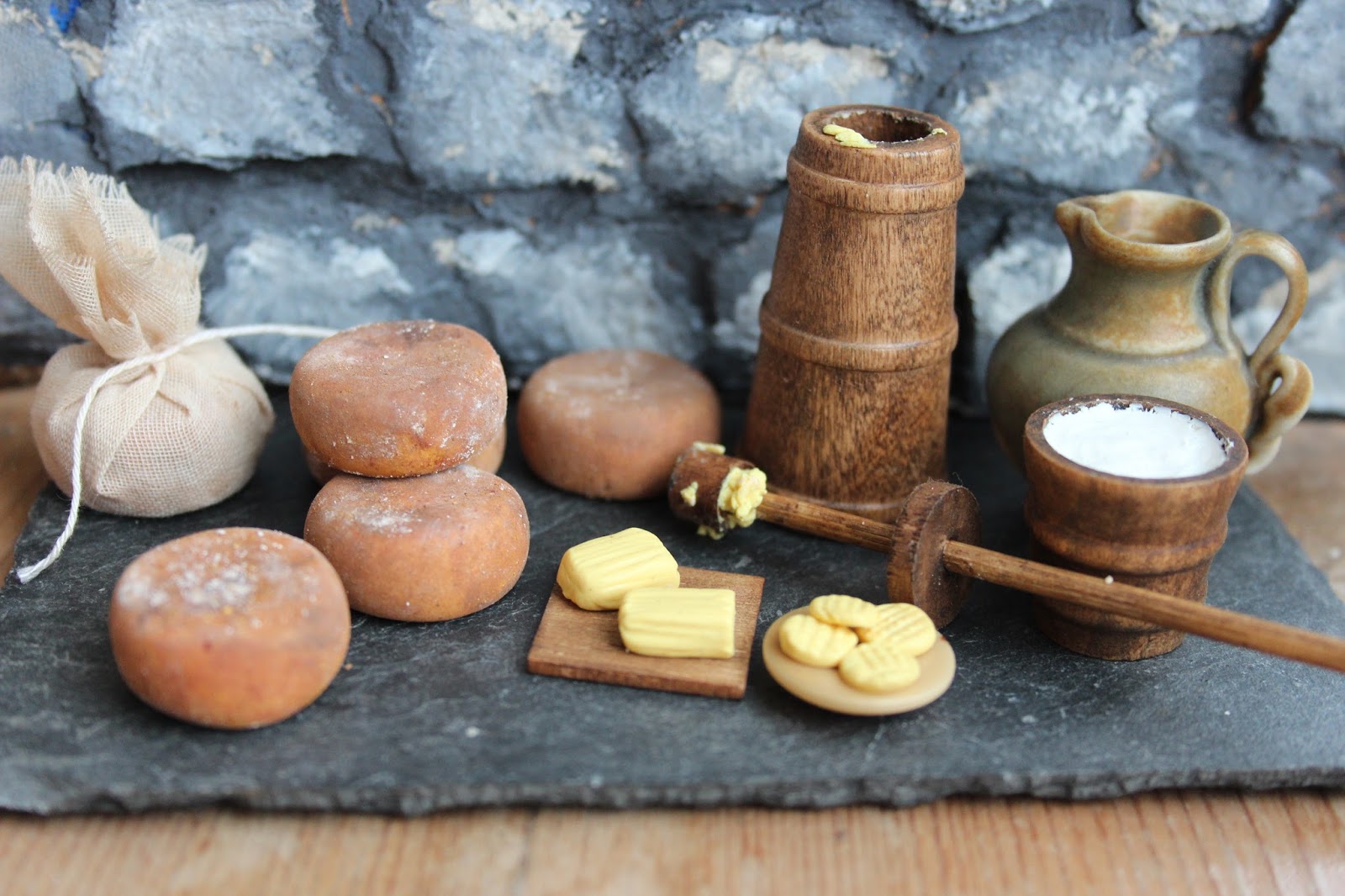
Miniature cheese for a 1:12 scale dollshouse, by MedievalMorselsMedievalMorsels
As a Christmas present I was given a slim volume on cheese making, a gift from my elder sister. There is one question puzzles me. And it has always puzzled my sister’s oldest friend, who has had a keen interest in history all her life.

Why is it in England that we have always been so fond of cow's milk and its dairy products whereas as a nation we have tended to shun goat's and ewe's milks and their cheeses? Generally speaking this seems to hold true for our Medieval forebears as well.

Copyright Public domain: Luttrell Psalter c.1325-1335 sheep milking pen


Cheese making, but not by monks.  A Medieval/Renaissance woodcut.

The slim volume, alas, did not answer this directly. But it did shed light on the question by revealing what I believe to be a very strong hint. It let slip the interesting fact that Wensleydale cheese, made by Cistercian monks in Yorkshire since 1115, was originally made from sheep's milk. Cow's milk was only substituted much later. Now, I have also learned from the radio this week  that the Cistercian monks, when they broke away from the Benedictine order, preferred a hard life not an easy one. So they settled in very remote locations.

One imagines then that in Upper Wensleydale the Cistercian monks were, with help from lay shepherds who were part of their self sufficient community, able to tend flocks of milking ewes. Hardier and less expensive to keep than cattle, they would have endured the wintery conditions better than cattle or indeed the monks themselves. In fact the monks had to relocate to Lower Wensleydale in later years because of inclement weather and hostile natives!

Cheshire or Wensleydale  type cheese, 12th scale dollhouse food for a period setting


MedievalMorsels' pale crumbly Wensleydale, Cheshire texture
Cheddar making in Somerset goes back more than 800 years with records from King Henry II’s accounts showing that in 1170 the King purchased 10,240 lbs (4.6 tonnes) of Cheddar cheese at a cost of a farthing (a quarter penny) per pound weight. He declared Cheddar cheese to be the best in Britain and his son Prince John (later “Bad King John” reigning between 1199 and 1216) thought the same. Why? Because there are records of him continuing to buy the cheese for the great Royal banquets.

The land around the village of Cheddar has been at the centre of England's dairy industry since at least the 15th Century and, being prime land, one tends to assume by then it was based upon herds of cows and not flocks of sheep. Its earliest origins may have lain with sheep however...

And for other ancient English cheeses, whose large scale production started in the Middle Ages, there is tantalising early reference to sheep’s milk. Originally cheese made in the valley of the River Severn was made from the milk of Cotswold Sheep. As early as 1498 so much cheese was being made in Gloucester that a permanent market was set up in the City of Gloucester, the site of it’s indoor market today. But by Tudor times (post 1485) cow’s milk was the norm across the Vale of Berkeley and down to Bristol. This came mainly from Old Gloucester cows whose milk was ideal for cheese-making with small fat globules that made a fine even textured cheese. In 1745 cattle plague all but wiped out the breed and was replaced by the Longhorn cow, with no reversion back to sheep!  Double Gloucester cheese, probably made with the previous evening's skimmed off cream set by, was a prized cheese comparable in quality to the best Cheddar or Cheshire, and was exported out of the county. Whereas an inferior Single Gloucester tended to be consumed within the county.

And all this without mentioning that Cheshire cheese is England's oldest cheese! The claim that Cheddar cheese is referenced by name in the Doomsday Book of 1086 cannot be substantiated, it would seem. A rival claim is for Cheshire cheese, also not substantiated, but actually likely to be England's cheese of cheeses! The Doomsday Book would amply demonstrate, I am sure, that many more sheep, goats and pigs were kept than indulgent milking cows in the 11th century! I suspect the same probably cannot be said of beasts of burden, oxen.


So a picture does emerge of England’s dairy practice in Medieval times first evolving patchwork like around clusters of sheep’s milk production, and then moving up a gear as the Englishman’s appetite grew for cheese grew with cow’s milk production concentrated in valley areas of lush pasture.

One inch scale cheese,  Parmesan for a Medieval Tudor or Renaissance dolls house
And just a word on Parmesan cheese, or Parmigiano Reggiano®  as it is now known.  An ancient cheese made by monks in Parma, Italy from skimmed cow’s milk. Imported into England in Medieval and Tudor times, Samuel Pepys buried his "Parmazan cheese" during the Great Fire of London of 1666 "...as well as his wine and some other things" to preserve them. Historical documents show that in the 13th and 14th centuries, Parmigiano (Parmesan cheese) was already very similar to that produced today, which suggests its origins can be traced to a far earlier Medieval times. And sheep rather than cows originally I wonder?

And what about England’s “red” cheeses such as Red Leicester? Lets just leave that story for another blog post shall we? But here is a miniature taster by MedievalMorsels!

Red Leicester cheese for a period or rustic 1;12 scale setting by MedievalMorsels