Tuesday, 23 June 2015

Wimbledon, Hampton Court, Henry VIII and strawberries - anyone for tennis?

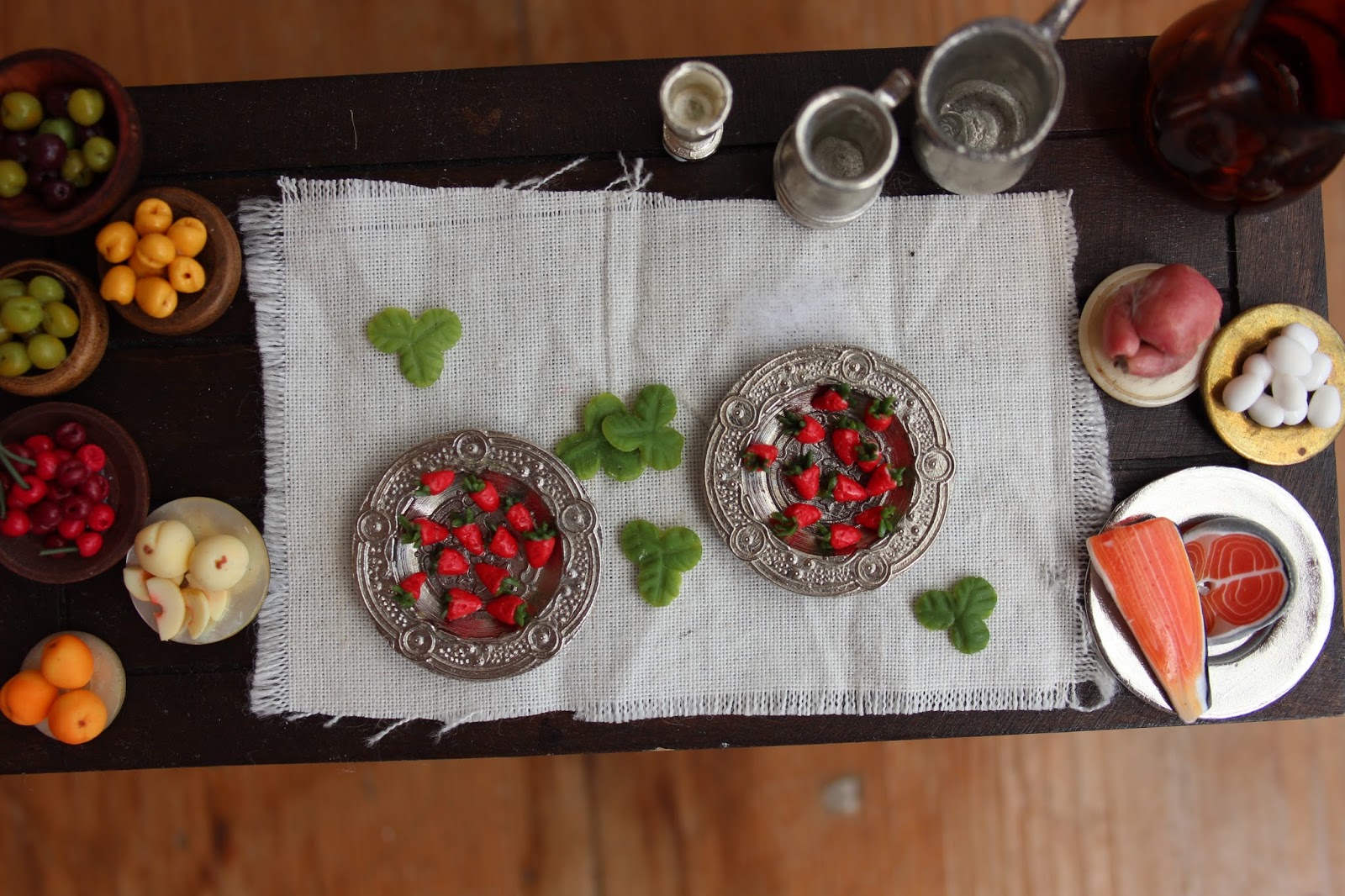
Silver server of strawberries, fit for Tudor formal dining or served alongside a Real Tennis court!

Wimbledon fortnight is upon us and the world’s attention is centred on that court, the aptly named Centre Court. And yet Wimbledon’s illustrious All England Lawn Tennis and Croquet Club, to give it its current full title, owes its existence to a much earlier adopter of the sport of tennis in England. That game changer was no less than the 6ft 4inches, athletic, young King Henry VIII.


So not a million miles away from SW1, in fact less than ten miles distant, it is another other tennis court that fascinates. Henry was an enthusiastic proponent of the game of “real tennis”, a worthwhile pursuit among the noble class that was designed to  “...chase idleness , virtue’s mortal enemy…”. After playing on the indoor court at Hampton Court Palace- for it was an indoor game - how would Henry have refreshed himself after vanquishing all the finest players in his noble entourage?

One inch dolls house fruit, handmade strawberries for Medieval, Tudor, Regency luxury dining


Why, with some strawberries of course! MedievalMorsels has modelled the very same and arranged the trophy fruit on an ornate plate resembling the Ladies allcomers challenge trophy. Strawberries were a tricky plant from which to grow fruits in any quantity or size. Probably Tudor strawberries were no bigger than today’s wild Alpine strawberries. But other delicious garden summer fruits would make a thirst quenching and natural sugar laden post-set snack. Henry would have uppermost on his mind the exotic varieties of cherries, peaches, plums and apricots - all carefully tended by his gardeners, grown from new varieties imported from the Low Countries (Belgium and Flanders) and Italy in particular. And MedievalMorsels takes pleasure in modelling these too.


Dollshouse miniature food, summer cherries at 1:12 scale from MedievalMorsels

Twelfth scale peaches for a period dolls house, miniature dollhouse fruit by MedievalMorsels
One inch scale dollhouse fruit, plums of all types for a Medieval, Tudor or modern rustic dining scene


It was Cardinal Wolsey who actually built Hampton Court Palace with its real tennis court. But he had not long been in possession of it than he was rapidly falling out of royal favour. He had still failed to secure a Papal anulment for Henry’s 26 year marriage to his brother’s widow, Katherine of Aragon. With no male heir Henry planned, of course, to marry Anne Boleyn. Wolsey made Henry a present of Hampton Court, which he had built between 1526 -1529.


Fast forward just a few years and it is said, on Hampton Court Palace’s website no less, that Henry’s second wife - Anne Boleyn - was gambling on a game of (real) tennis when she was arrested to be taken to the Tower of London. She even complained that she couldn’t collect her winnings! Whether we are really to believe this I cannot say...


Although it looks like a strange combination of tennis and squash, according to The Royal Tennis Club “the techniques, strategies and rules are more complex than for the modern derivatives”. Each ball contains a core wrapped around with some thirteen yards of webbing in half inch widths, and in fact many balls in use today started their life over a century ago but have been re-covered! The tennis racquets are usually made from hickory or ash with sheep gut still commonly used for the strings. The curious shape of the head of the racquet is designed to help the player to cut the ball by having a large area of strings across which a ball can sweep diagonally. By contrast today’s lawn tennis players employ top-spin.


Real tennis is the original indoor racquet sport from which the modern game of tennis is descended. It only acquired its ‘real’ tag at the end of the 19th century to distinguish it from the new-fangled ‘lawn’ tennis. The number of real courts has actually risen in the last thirty years. There are now 27 in Britain, 10 in the USA, 3 in France and 6 in Australia. Despite there being no more than a few thousand real tennis players in the world, they make up in keeness for any lack in numbers, organising professional and amateur tournaments practically all year round.


“The Club”  that has given rise to the current Wimbledon tournament however was founded some three centuries later in 23 July 1868 but at the height of a croquet craze! The then-infant sport of Lawn Tennis was introduced in 1875, when one lawn was set aside. The first tennis Gentlemen's Championship in Singles was held in July 1877. Wimbledon’s present Centre Court, built in 1922 upon the move of the Club, was not actually in the centre at the time it was built, but it is so now. British viewers will be eager to follow Andy Murray’s progress especially as he has just won a grass warm-up tournament at Queens for a record fourth time, but lets hope all the ‘great’ players, newcomers, ‘wild cards’ and  underdogs alike have a splendid Wimbledon this year. Some of my favourite players have been Arthur Ashe, Ilie Nastase, John McEnroe and Miloslav Mečíř - players of touch before the advent of the power game, double handed backhands and power racquets (do I mean rackets?).  


With its retractable roof and flood lighting, modern Centre Court is equipped to deal with rain and the failing light of late running matches - remember there is no tie-break in a final set at Wimbledon! Rain never posed a problem for real tennis players, the grilled window in one wall, through which light, but not rain poured, was a featured “hazard” attracting penalties if you hit it. Now if anyone can explain real tennis in simple terms, I’d be surprised. Cambridge University Real Tennis club describes it thus “...subtlety and thought are more prized than power and fitness. It is played in an asymmetrical court which contains many unusual features, sloping roofs, openings (galleries) in the walls and a main wall which has a kink in it (tambour) so the ball on hitting the sloping face moves across the court instead of continuing down the line of the main wall. It has the classic elements of warfare where a failed attack is punished by a counter-attack.”

Saturday, 13 June 2015

Magna Carta, Bad King John and Lampreys

A dish of lampreys fit for a King or Queen, 12th scale period dollhouse food by MedievalMorsels
June 15 th 2015 is the 800th anniversary of Magna Carta! That is to say the anniversary of King John agreeing to attach his Royal Seal to the historic document. To be honest, the term Magna Carta (great charter) may be more significant to your average American than your average Brit. But I suspect there will be plenty of media attention in the UK and perhaps we will trawl up memories of mostly forgotten history lessons….What’s the fuss, was King John really so bad and why might our American cousins be more enamoured of this anniversary than we can truthfully  admit? And what on earth do lampreys have to do with it?
King John and his second wife Queen Isabella by Angeliqueminiatures, about to set upon their lamprey feast!

A lattice pie by MedievalMorsels filled with John's favourite food, lampreys! Medieval dollshouse one . food
King John was not a good man, not at least according to A A Milne (he of Winnie-the-Pooh fame) in his poem written in 1927. In this enchanting verse we grow to feel sorry for King John as he anticipates no presents again in his stocking at Christmas! Whilst all the time he  really does want a big, red,  India rubber ball. Charming and anachronistic, I had a copy of Milne’s poetry anthology “Now We are Six” on a suitable birthday! Why did people revile him?
England's crown passed to "bad" King John (1167-1216) on the death of his brother, Richard so-called Lionheart. John had  earlier tried to “usurp” the crown while Richard was away doing what he liked best, fighting battles overseas. So he wasn’t trustworthy then. The mighty Barons of England’s shires saw that John abused his power as monarch. Through his outrageous behaviour John had managed simultaneously to alienate all three orders of Medieval society in his realm. First, the powerful nobility - the barons and lesser nobles. Second, the Church - for six years of his rule the Pope ordered churches to be closed and finally he excommunicated John. And last, the remaining 90% of the population, John’s unfair rulings had alienated the peasants. Exasperated the Barons took London and invited Prince Louis, heir apparent to the King of France, to rule England. John was at Windsor Castle and both factions met at Runnymeade on the River Thames to negotiate terms. Such was their mistrust,  the Barons were not going to let him leave without signing. On 19 June 1215, with the Seal presumably affixed by court officials, the Barons then finally swore their allegiance to John.

 Louise Goldsborough Bird creates historically accurate 12th scale dolls, MedievalMorsels can supply their favourite foods!
Magna Carta was without precedent, drawn up to protect all “free” men by calling on the law, and fair judgement by equals (a jury as we would now say). And no longer to be subject to the whim of the power crazed, autocratic and selfish King John. Clause 39 states that “No free man is to be arrested, or imprisoned, or disseised, or outlawed, or exiled, or in any other way ruined, nor will we go against him or send against him, except by the lawful judgment of his peers or by the law of the land.”  The "villeins" or unfree tenants were excluded, technically they fell within the jurisdiction of their lords.
In essence most of Magna Carta’s 63 clauses granted by King John, under duress he would later argue, dealt with specific grievances relating to his rule. The Barons sought to make the despotic King John subject to the law of the land, but within three months of attaching his seal John petitioned the Pope for its anulment. After John’s premature death however the Baron’s swiftly resurrected an updated Magna Carta. Although nearly a third of the text was deleted or substantially rewritten within ten years, and almost all the clauses have been repealed in modern times, Magna Carta remains a cornerstone of the British constitution. Some of Magna Carta’s core principles, Clause 39 in particular, are echoed in the United States Bill of Rights (1791) and in many other constitutional documents around the world, as well as in the Universal Declaration of Human Rights (1948) and the European Convention on Human Rights (1950).  


The same King John loved to eat lampreys, eel like fish which happened to be a favourite dish of earlier  English Royal courts. Some centuries before, King Henry I (1068-1135) was also known for his lust of eating them, reportedly dying from a "surfeit of lampreys" as one chronicler elegantly put it. This befell that particular monarch on a hunting trip to France and since, like most early  English monarchs, Henry was really more French than English perhaps a gastronomic death in France was fitting! Most historians believe that he died from food poisoning, but quite possibly it was the lampreys "wot did it ".

Well, the same fate befell quite plausibly befell King John. Soon after learning his baggage “train” and its treasure including his crown jewels were lost in the Fenland marshes he too sucumbed to food or some other more sinister poisoning, dying at Newark Castle. Whether his last meal included the exceptionally fatty and highly indigestible lamprey Medieval chroniclers do not say, but I imagine they were easy to trap in the marshes and we know that he often called ahead for such a dish of lampreys to be prepared and even brought out to meet him as he approached a town on his "Royal Progress".
So great was the demand for lampreys during his reign, that John issued a mandate to the sheriffs of Gloucester, where the best were to be found, forbidding the first lampreys of the season to be sold for any more than two shillings a piece. This sounds very expensive indeed! According to the Royal Cookbook, King John also levied a fine of 40 marks (a mark was about two third of a pound) on the city of Gloucester for failing to "pay him sufficient respect in the matter of his lampern." Perhaps they had forgotten him at Christmas?! Or to send a lamprey pie to meet him at the city gate. Embarrassing because his first wife, before acceding to the throne, was Isabella of Gloucester. Perhaps the bad temper levelled at Gloucester really arose because he wanted to divorce her for a younger bride now he was to be King Notably the very beautiful and much younger Isabella Countess of Angouleme, France.
Queen Isabella, Countess of Angouleme, may not have shared her husband's enthusiasm for lampreys

Unlike other fish, the lamprey has no scales, jaws, gill covers or bony skeleton. Fossil evidence has shown lampreys date from before dinosaurs, evolving some 250 million years ago and belonging to a near-extinct family of jawless fishes. So now for some unpalatable natural history about the ancient sea lamprey (Petromyzon marinus). A lamprey's downward slanting mouth consists of a large, tooth-lined sucking disc. Once it has latched onto the side of another fish, the lamprey opens a hole in its host by wiping its raspy tongue across the skin. The parasite (because that is what a lamprey is!) then secretes an anticoagulant that keeps this wound open so that the lamprey can feed on the prey's blood and tissue.

Saturday, 30 May 2015

Wild boar, New Forest inhabitants of old

MedievalMorsels' 12th scale boars heads for your period dollshouse
I have just listened to a programme on BBC Radio called "The Kitchen Cabinet", it was dedicated to the New Forest. I should really make an effort to listen more often because as well as loads of food history, you hear from local experts notably food producers and chefs.

Now, I did know a bit about the New Forest. I have camped there for one. In a very rudimentary Forestry Commission campsite as I recall with one loo and one tap. Unfortunately on sloping land! I am sure it is either closed or has been "glammed" up by now. I do recall the lack of facilities meant we had to wash in a brown, brackish stream in the forest.....we only camp in hot weather. The abundant foxgloves afforded us some modesty! As far as I know there were no quadrupeds watching us, but on our rambles we did bump into horses, cattle, sheep and pigs. Back then I am not sure there were wild boar in the forest, but there are escaped specimens estimated at several hundreds today.
A taxidermist's young wild boar, on sale at Tewkesbury medieval fayre in 2014


A nose garland of leaves for this one inch scale boar's head

Regarding miniatures though,
I have shared a stall with my sister at a dollshouse fair at Lyndhurst in the New Forest too! And since I model boars' heads I had to "bone up" on Medieval forest practice, so as to provide an accurate context for a boar head at the feast. 

The radio programme reminded me that the New Forest is England's oldest, having been declared a royal hunting chase or forest by William Duke of Normandy, aka William the Conqueror, in 1079. It is the only forest where the ancient peasant right of pannage remains - for a levy you bought or buy the right for your livestock to forage for food, notably mast - acorns and beech nuts. In September at the start of the acorn season the pigs and wild boar, and today's hybrid breeds such as the Tamworth pig, come into their own. The digestive systems of horses, cattle and sheep do not benefit from grazing on acorns, so out porcine friends are positively encourage to hoover them up. Do acorns contain arsenic or similar I wonder?
The Tamworth breed of pig, crossed with the wild boar

We heard how the nutty flavour is transferred to the meat, especially the fatty meat of pigs. Boar meat on the other hand is lean, and pretty tough if the animal has been running around a good few years. Wild Boar were in fact extinct in the wild by the C13th, they were hunted and eaten out of existence. And efforts to re-introduce them in the C16th and 17th met with exactly the same problem! That's what an aristocracy can do for you....

We also heard that in Victorian times a boar's head would be singed of hair and bristles, soaked in brine for two weeks then roasted. Next it was "pimped" with the obligatory apple in it's jaw, artistically arranged port wine jelly, a piped family crest, and leaves or even garlands. Really, it sounds as if no-one wanted to eat the thing. And perhaps the dish was little better in Medieval times? Certainly boars heads, a dish reserved for the nobility, were glammed up in Medieval and Tudor kitchens too. Well I certainly had fun pimping mine, as you can see!

MedievalMorsels' pimped boar's head a la Medieval feast, Victorian dining!
A relic of the mast system still survives in Spain today where black and red  Iberian swine feed in oak woodland on the Sierra Morena, producing a delicious, sweet, melt in your mouth  dry-cured ham called jamon iberico. Now we are talking ham!


MedievalMorsels 12th scale leg of ham 
Medieval, Tudor feasting one inch scale


Sunday, 24 May 2015

Let them eat Bread!


Dark rye breads by MedievalMorsels , miniature breads for the one inch period dollshouse
Bread. A staple food of so many civilisations. It can be, and is, made with almost any grain you care to imagine. But it can be, and has been throughout history, adulterated with non-grain products along the way if grain proves too expensive! Additives such as clay, alum, chalk, ground bones, potash or pea (vetch) flour!


Cereals germinate and grow well in particular temperature and soil conditions, so there have been marked regional variations in what is cultivated in different areas of the northern hemisphere from earliest times. And man didn't necessarily have to grind locally grown cereals into a flour! After all, millstones could be in short supply if the geology wasn’t right. (I guess they were traded?) Precisely how much time can one afford to dedicate to grinding  grain if there are other time consuming chores that must be done to keep body and soul together, to eek out an existence? A coarse bread made from pounded, crushed grain meal would suffice and be just as nutritious, if a little harder wearing on the teeth!


A peasant in Medieval Europe was more likely to use pounded grain in his cooking pot, or make a “mash” or porridge mixed with water, than to bake bread. Buckwheat - which would grow just about anywhere - was a favourite for porridge or pancakes. Or the same peasant might make “maza” an unleavened cereal meal dough paste, thicker than porridge, which could be shaped and baked on a stone in the embers of the fire. In Scotland barley meal used in this way would produce a barley bannock.


Mixed grain wholemeal "maslin" loaves, perfect for a 12th scale Tudor dollhouse


The craft of breadmaking was recognised from the 6th Century (the Dark Ages). In the Middle Ages in Medieval society both the master miller and the master baker were allowed to mill or “bolt” flour. Using the lord’s, or the abbot’s grain traded locally.
Dolls house miniature food by MedievalMorsels, bread loaves for a period, pioneer or rustic dollhouse


In fact the word “lord” derives from an Old English word  hlaford  meaning "master of a household, ruler, superior," and even earlier still from the German word hlafweard, literally "one who guards the loaves," from the word hlaf "bread, loaf". This direct connection is because a lord maintains and feeds his household, and offers hospitality to the traveller. The word lady  derives from Old English hlǣfdige, the dige part related to our word dough, which became lady by 1382, and literally means "bread-kneader". The Old English hlafæta is a "household servant," literally "loaf-eater." So “lord” and “lady” both retain vestiges of their original meanings, but as the Free English Dictionary by Farlex remarks - England's aristocrats have not been elbow deep in flour, let alone dough, for several centuries!


By contrast MedievaMorsels has been kneading dough, or more accurately Fimo modeller’s clay!

Period, rustic loaves by MedievalMorsels
1:12 scale dollshouse bread
I have extended the range of period breads for a Dark or Middle Ages dolls house, a Tudor, Renaissance dollhouse or a Colonial, pioneer setting. 

But these loaves would look equally at home in a modern dollshouse, rustic dirama or market scene. I have added introduced large rolls, as well as loaves because at a meal, or indeed a feast, the noble company on the top table may well have been served an individual, fine white manchet loaf. Though we may fancifully believe otherwise, bread was in fact a very large part of the upper class, noble diet whilst the humble peasant was not allowed to mill flour or bake bread. If he could not afford to buy it, he and his family would make do with pounded cereal meal added to the family cooking pot.

MedievalMorsels is now on FaceBook! Please visit and "like" if you can!

Saturday, 16 May 2015

Fair means or fowl?

12th scale roast goose - the Medieval meal for Michaelmas, celebrating harvest's end.
In England herds of geese were walked into London and other large centres of population in advance of seasonal fairs that marked the Church’s important religious festivals. “He who eats goose on Michaelmas day shan't money lack or debts to pay.” In Germany a fruit filled goose was eaten on high days and holidays, including Michaelmas (29 September).


Nottingham’s Goose Fair (originally a “Goods Fair”) was granted a charter by Edward I in 1284 from the eve of the feast of St Edmund and for twelve days following. Michaelmas (autumn, fall) fairs were important for trade because town and country dwellers alike, rich and poor, had to stock up with goods, such as cheese and ham, against the risk of isolation and starvation during the dark days of winter. The change of name to Goose Fair was first mentioned in the Nottingham Borough Records of 1541. The fair typically saw the arrival of over 20,000 geese raised on the flat, low-lying Fenland in Lincolnshire and sold to provide the traditional Michaelmas dish. I used to live in Nottingham and seven centuries later the fair is still referred to as the Goose Fair. It offers mechanical rides amongst its principal  attractions, but not live poultry. However I don’t remember if “hook a duck” stall was a “hook a gosling” stall. Obviously, it should have been.


And what of the fowl in the title of this post? As well as modelling some more roast geese to replace stock, I have made MedievalMorsels’ first hanging chickens. 
24th scale chickens to hang by MedievalMorsels, these ones cut off at the knee!

A challenge because this was a custom order at half inch or 24th scale, much more fiddly! But it was good practice and now scaling up to the more typical 1:12 or 12th (one inch) should prove easy.

But its not just chickens.  For a while now, I have longed to model guinea fowl, I don’t know why.

Medieval, Renaissance, Tudor fare: roast guinea fowl, one inch scale dollshouse food 
Detail from Caravaggio's "The Supper at Emmaus" 1601 with a splendid guinea fowl
 It may be something to do with the fact they have elegant plumage and proportions - long, blackish legs and a deep breast. They were popular with the noble classes, enjoying their heyday with the goose before the turkey reached Britain’s shores. They are sometimes to be found in English supermarkets and they taste very nice actually. But the real reason is probably that Caravaggio painting that lurks in my mind, its still life element includes guinea fowl and interesting “tear and share” bread! See what you think!


So my first guineafowl is previewed here in this blogpost. I can’t offer it for sale in my online shop until I have made at least a brace (pair) of them. 

Last I have sad news about MedievalMorsels’ pheasants. I have made more bodies but unfortunately I have clean run ot of feathers!
A work in progress - nude fowl by MedievalMorsels - awaiting genuine pheasant feathers

 I phoned an illustrious butcher who deals in game yesterday asking about the availability of feathers and was told to get back in touch in the game season, which starts  for pheasants in September. Road kill it is then, although there is precious little of that in Swindon. I have asked friends and family to be on the look out. I guess I should provide the latex gloves!

Thursday, 7 May 2015

What a nice pear!


Beware! You cannot rely on shape to tell the difference between an apple and a pear! 


Pears belong to the ancient Rosaceae (Rose) family dating back 100 million years, when the flowering plants were starting to colonise the planet. By contrast just 100 years ago botanists lumped together pears and apples together into one genus “Pyrus”, whilst today they are separated (apples being now classified in the “Malus” genus).
Dollshouse miniature food, MedievalMorsels' 12th scale pears 

 The genus Pyrus, native to the Northern Hemisphere of the Old World, consists of about 20 wild species of which half are found in Europe, North Africa, and Asia minor; and half in Asia. These have given rise to two groups of cultivated pears, the soft-fleshed European Pyrus communis and the crisp-fleshed Asiatic pears.


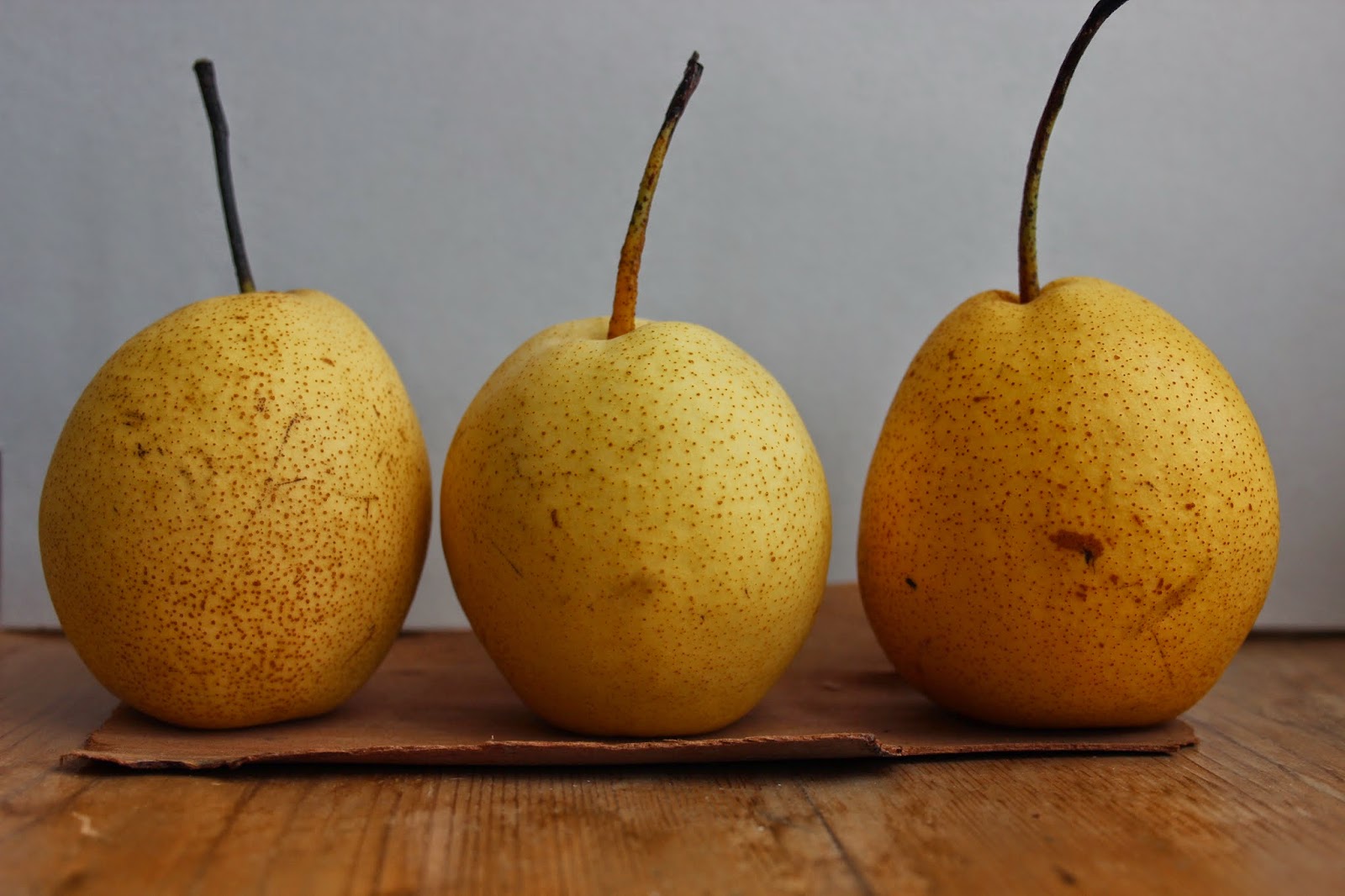
Asian pears, long distant cousins of European pears and crisp fleshed!

Here are some splendid examples of the latter, bought at a local supermarket. These are the Shandong variety of Asian pear were grown in China, and come regrettably with a carbon footprint. But what a fine pair, and one to spare!

In Asia, the culture of pear goes back 2500–3000 years and has been chronicled in Chinese writings from at least 1200 years ago. Pear was long considered a delicacy for the wealthy, along with the peach and apricot.

The precise origin of the European pear is still unknown but it has been with us since prehistoric times and dried slices have been unearthed in Swiss cave dwellings of the Ice Age.

A popular fruit of Medieval and Renaissance (Tudor in England) times pears were used much as a vegetable to add bulk, texture and to sweeten to pottages, stews, sauces for meats and fillings for pies. Pies such as this 12th scale dollshouse miniature made by MedievalMorsels.
Pears, which generally needed to be cooked, were used just like vegetables in Medieval, Tudor pies!

Cross pollination between orchard grown and wild pears was easy, so there was a viable, long-lived (up to 300 years for an individual pear tree) naturalised wild stock producing pears. Meaning there were plenty to go around in season, even in a peasant home. But there was a drawback!  These pears had to be cooked. Poaching in sweet red wine was a favourite dish for the nobility. I had a go at this dish during the Richard III re-interment and reburial celebrations, but I did not have good light to photograph the end result by!

Pears in wine with spices including cinnamon sticks, made by me!


According to expert Jim Chapman, Harris fruiterer to Henry VIII, introduced a wide range of dessert pears which did not need cooking from France and the Low Countries in 1533.  That made life easier then! But research indicates that the Romans probably introduced the original, hard cultivated pear to Britain, where the wild pear already existed. After the Romans left, in Anglo-Saxon times a pear tree was one of the six most common trees cited as boundary markers. I think that is a lovely thought! And the spread of the monastic movement throughout Europe, including Britain, ensured that Roman knowledge of pear culture was not forgotten. Hooray!


Tuesday, 28 April 2015

You've got the plague!

Mixed grain breads at dolls house 12th scale by MedievalMorsels

I was sitting outside last week. Spring has really sprung now, here in southern England.

My father used to partially quote, or misquote, a poem
"Spring is sprung,
the grass is ris!"
This nonsense poem has more lines. About birds and wings and things. But being of a then very tender age, I do not remember him reciting more, although he probably completed the poem. (He also liked to quote "Hiawatha" by Longfellow). Should you need to know, the above lines are attributed to one or other of: the English nonsense verse writer E.E. Cummings or the American poet Ogden Nash. But in reality we probably must put them down to Anon!

Anyway, I was sitting outside "distressing" some dollhouse wooden bowls and plates. Children were running home from school and I heard some words that suddenly brought back memories because, in my obviously uncaring youth, I had often uttered them too. I bet you did as well. And, what is more I bet millions of children across Europe have shouted this taunt for more than 100 years now, even though it references go even further back to Medieval times. Tell me, did your school playground taunts and tag games involve this now overheard and very mean-spirited slur?

 "You've got the Plague! You've got the Plague!"

The Black Death, the most virulent of a series of outbreaks of the bubonic plague, killed a massive proportion of the Medieval population across Europe during the years 1348-1350. In England alone it killed nearly a third of the population, and London's population was halved. The pestilence followed all of the trade routes to every country, carried by fleas on rats. It was believed to have originated in the Gobi Desert.  I really didn't know that. I thought it came to England, London probably, on ships from Norway. And perhaps it did! 
 
Malnutrition in England, due to bad weather conditions and consecutive failed harvests, was a reason why so many people sucombed to this malaise so easily. Death was swift, so you could say that a taunt that you had the plague was particularly cruel! Chances are though, that the taunter would have be incubating the dreaded disease as well! 


More one inch miniature food -bread- as featured in Wolf Hall by MedievalMorsels

 Wheat and other failed cereal crops either could not germinate or were flooded or blown down by driving rain. This meant a shortage of cereal meal thickening for pottages and for making bread. 
 And limited availability for pastry "coffyns", such a Medieval favourite.
A small chewetty or pie by MedievalMorsels
Fancy table pie with minced meats and fruits, spices


Root vegetables and beans rotted in the fields.

12th scale onions grown by MedievalMorsels

Organic dollhouse vegetables, cabbages by MedievalMorsels
In England the population drop following the Plague resulted in a higher value being placed on labour - the Peasants Revolt followed in 1381 challenging young King Richard II's authority. He, incidentally, grew to be a thoroughly disliked monarch, which is saying something by English Medieval and Tudor standards!

But farming and life for a peasant changed in the years after the Great Plague. The wool industry boomed. Less land was worked because previous levels of food production were no longer needed. They were less mouths to feed! The canny tenant Lord looked to save his money so indentured peasant labourer lost out to the more profitable woolly coated sheep. Many medieval hamlets and villages, devastated by Plague in the first place, were now abandoned as land-use changed and the less viable countryside could no longer sustain a working population.

Plague was to return many times in Europe and England. The Great Plague of 1665 brought death on a massive scale once again. A late as 1900 Australia and Portugal had outbreaks of bubonic plague.

MedievalMorsels is now on FaceBook! Please visit and @like@ if you can!