Saturday, 30 May 2015

Wild boar, New Forest inhabitants of old

MedievalMorsels' 12th scale boars heads for your period dollshouse
I have just listened to a programme on BBC Radio called "The Kitchen Cabinet", it was dedicated to the New Forest. I should really make an effort to listen more often because as well as loads of food history, you hear from local experts notably food producers and chefs.

Now, I did know a bit about the New Forest. I have camped there for one. In a very rudimentary Forestry Commission campsite as I recall with one loo and one tap. Unfortunately on sloping land! I am sure it is either closed or has been "glammed" up by now. I do recall the lack of facilities meant we had to wash in a brown, brackish stream in the forest.....we only camp in hot weather. The abundant foxgloves afforded us some modesty! As far as I know there were no quadrupeds watching us, but on our rambles we did bump into horses, cattle, sheep and pigs. Back then I am not sure there were wild boar in the forest, but there are escaped specimens estimated at several hundreds today.
A taxidermist's young wild boar, on sale at Tewkesbury medieval fayre in 2014


A nose garland of leaves for this one inch scale boar's head

Regarding miniatures though,
I have shared a stall with my sister at a dollshouse fair at Lyndhurst in the New Forest too! And since I model boars' heads I had to "bone up" on Medieval forest practice, so as to provide an accurate context for a boar head at the feast. 

The radio programme reminded me that the New Forest is England's oldest, having been declared a royal hunting chase or forest by William Duke of Normandy, aka William the Conqueror, in 1079. It is the only forest where the ancient peasant right of pannage remains - for a levy you bought or buy the right for your livestock to forage for food, notably mast - acorns and beech nuts. In September at the start of the acorn season the pigs and wild boar, and today's hybrid breeds such as the Tamworth pig, come into their own. The digestive systems of horses, cattle and sheep do not benefit from grazing on acorns, so out porcine friends are positively encourage to hoover them up. Do acorns contain arsenic or similar I wonder?
The Tamworth breed of pig, crossed with the wild boar

We heard how the nutty flavour is transferred to the meat, especially the fatty meat of pigs. Boar meat on the other hand is lean, and pretty tough if the animal has been running around a good few years. Wild Boar were in fact extinct in the wild by the C13th, they were hunted and eaten out of existence. And efforts to re-introduce them in the C16th and 17th met with exactly the same problem! That's what an aristocracy can do for you....

We also heard that in Victorian times a boar's head would be singed of hair and bristles, soaked in brine for two weeks then roasted. Next it was "pimped" with the obligatory apple in it's jaw, artistically arranged port wine jelly, a piped family crest, and leaves or even garlands. Really, it sounds as if no-one wanted to eat the thing. And perhaps the dish was little better in Medieval times? Certainly boars heads, a dish reserved for the nobility, were glammed up in Medieval and Tudor kitchens too. Well I certainly had fun pimping mine, as you can see!

MedievalMorsels' pimped boar's head a la Medieval feast, Victorian dining!
A relic of the mast system still survives in Spain today where black and red  Iberian swine feed in oak woodland on the Sierra Morena, producing a delicious, sweet, melt in your mouth  dry-cured ham called jamon iberico. Now we are talking ham!


MedievalMorsels 12th scale leg of ham 
Medieval, Tudor feasting one inch scale


Sunday, 24 May 2015

Let them eat Bread!


Dark rye breads by MedievalMorsels , miniature breads for the one inch period dollshouse
Bread. A staple food of so many civilisations. It can be, and is, made with almost any grain you care to imagine. But it can be, and has been throughout history, adulterated with non-grain products along the way if grain proves too expensive! Additives such as clay, alum, chalk, ground bones, potash or pea (vetch) flour!


Cereals germinate and grow well in particular temperature and soil conditions, so there have been marked regional variations in what is cultivated in different areas of the northern hemisphere from earliest times. And man didn't necessarily have to grind locally grown cereals into a flour! After all, millstones could be in short supply if the geology wasn’t right. (I guess they were traded?) Precisely how much time can one afford to dedicate to grinding  grain if there are other time consuming chores that must be done to keep body and soul together, to eek out an existence? A coarse bread made from pounded, crushed grain meal would suffice and be just as nutritious, if a little harder wearing on the teeth!


A peasant in Medieval Europe was more likely to use pounded grain in his cooking pot, or make a “mash” or porridge mixed with water, than to bake bread. Buckwheat - which would grow just about anywhere - was a favourite for porridge or pancakes. Or the same peasant might make “maza” an unleavened cereal meal dough paste, thicker than porridge, which could be shaped and baked on a stone in the embers of the fire. In Scotland barley meal used in this way would produce a barley bannock.


Mixed grain wholemeal "maslin" loaves, perfect for a 12th scale Tudor dollhouse


The craft of breadmaking was recognised from the 6th Century (the Dark Ages). In the Middle Ages in Medieval society both the master miller and the master baker were allowed to mill or “bolt” flour. Using the lord’s, or the abbot’s grain traded locally.
Dolls house miniature food by MedievalMorsels, bread loaves for a period, pioneer or rustic dollhouse


In fact the word “lord” derives from an Old English word  hlaford  meaning "master of a household, ruler, superior," and even earlier still from the German word hlafweard, literally "one who guards the loaves," from the word hlaf "bread, loaf". This direct connection is because a lord maintains and feeds his household, and offers hospitality to the traveller. The word lady  derives from Old English hlǣfdige, the dige part related to our word dough, which became lady by 1382, and literally means "bread-kneader". The Old English hlafæta is a "household servant," literally "loaf-eater." So “lord” and “lady” both retain vestiges of their original meanings, but as the Free English Dictionary by Farlex remarks - England's aristocrats have not been elbow deep in flour, let alone dough, for several centuries!


By contrast MedievaMorsels has been kneading dough, or more accurately Fimo modeller’s clay!

Period, rustic loaves by MedievalMorsels
1:12 scale dollshouse bread
I have extended the range of period breads for a Dark or Middle Ages dolls house, a Tudor, Renaissance dollhouse or a Colonial, pioneer setting. 

But these loaves would look equally at home in a modern dollshouse, rustic dirama or market scene. I have added introduced large rolls, as well as loaves because at a meal, or indeed a feast, the noble company on the top table may well have been served an individual, fine white manchet loaf. Though we may fancifully believe otherwise, bread was in fact a very large part of the upper class, noble diet whilst the humble peasant was not allowed to mill flour or bake bread. If he could not afford to buy it, he and his family would make do with pounded cereal meal added to the family cooking pot.

MedievalMorsels is now on FaceBook! Please visit and "like" if you can!

Saturday, 16 May 2015

Fair means or fowl?

12th scale roast goose - the Medieval meal for Michaelmas, celebrating harvest's end.
In England herds of geese were walked into London and other large centres of population in advance of seasonal fairs that marked the Church’s important religious festivals. “He who eats goose on Michaelmas day shan't money lack or debts to pay.” In Germany a fruit filled goose was eaten on high days and holidays, including Michaelmas (29 September).


Nottingham’s Goose Fair (originally a “Goods Fair”) was granted a charter by Edward I in 1284 from the eve of the feast of St Edmund and for twelve days following. Michaelmas (autumn, fall) fairs were important for trade because town and country dwellers alike, rich and poor, had to stock up with goods, such as cheese and ham, against the risk of isolation and starvation during the dark days of winter. The change of name to Goose Fair was first mentioned in the Nottingham Borough Records of 1541. The fair typically saw the arrival of over 20,000 geese raised on the flat, low-lying Fenland in Lincolnshire and sold to provide the traditional Michaelmas dish. I used to live in Nottingham and seven centuries later the fair is still referred to as the Goose Fair. It offers mechanical rides amongst its principal  attractions, but not live poultry. However I don’t remember if “hook a duck” stall was a “hook a gosling” stall. Obviously, it should have been.


And what of the fowl in the title of this post? As well as modelling some more roast geese to replace stock, I have made MedievalMorsels’ first hanging chickens. 
24th scale chickens to hang by MedievalMorsels, these ones cut off at the knee!

A challenge because this was a custom order at half inch or 24th scale, much more fiddly! But it was good practice and now scaling up to the more typical 1:12 or 12th (one inch) should prove easy.

But its not just chickens.  For a while now, I have longed to model guinea fowl, I don’t know why.

Medieval, Renaissance, Tudor fare: roast guinea fowl, one inch scale dollshouse food 
Detail from Caravaggio's "The Supper at Emmaus" 1601 with a splendid guinea fowl
 It may be something to do with the fact they have elegant plumage and proportions - long, blackish legs and a deep breast. They were popular with the noble classes, enjoying their heyday with the goose before the turkey reached Britain’s shores. They are sometimes to be found in English supermarkets and they taste very nice actually. But the real reason is probably that Caravaggio painting that lurks in my mind, its still life element includes guinea fowl and interesting “tear and share” bread! See what you think!


So my first guineafowl is previewed here in this blogpost. I can’t offer it for sale in my online shop until I have made at least a brace (pair) of them. 

Last I have sad news about MedievalMorsels’ pheasants. I have made more bodies but unfortunately I have clean run ot of feathers!
A work in progress - nude fowl by MedievalMorsels - awaiting genuine pheasant feathers

 I phoned an illustrious butcher who deals in game yesterday asking about the availability of feathers and was told to get back in touch in the game season, which starts  for pheasants in September. Road kill it is then, although there is precious little of that in Swindon. I have asked friends and family to be on the look out. I guess I should provide the latex gloves!

Thursday, 7 May 2015

What a nice pear!


Beware! You cannot rely on shape to tell the difference between an apple and a pear! 


Pears belong to the ancient Rosaceae (Rose) family dating back 100 million years, when the flowering plants were starting to colonise the planet. By contrast just 100 years ago botanists lumped together pears and apples together into one genus “Pyrus”, whilst today they are separated (apples being now classified in the “Malus” genus).
Dollshouse miniature food, MedievalMorsels' 12th scale pears 

 The genus Pyrus, native to the Northern Hemisphere of the Old World, consists of about 20 wild species of which half are found in Europe, North Africa, and Asia minor; and half in Asia. These have given rise to two groups of cultivated pears, the soft-fleshed European Pyrus communis and the crisp-fleshed Asiatic pears.


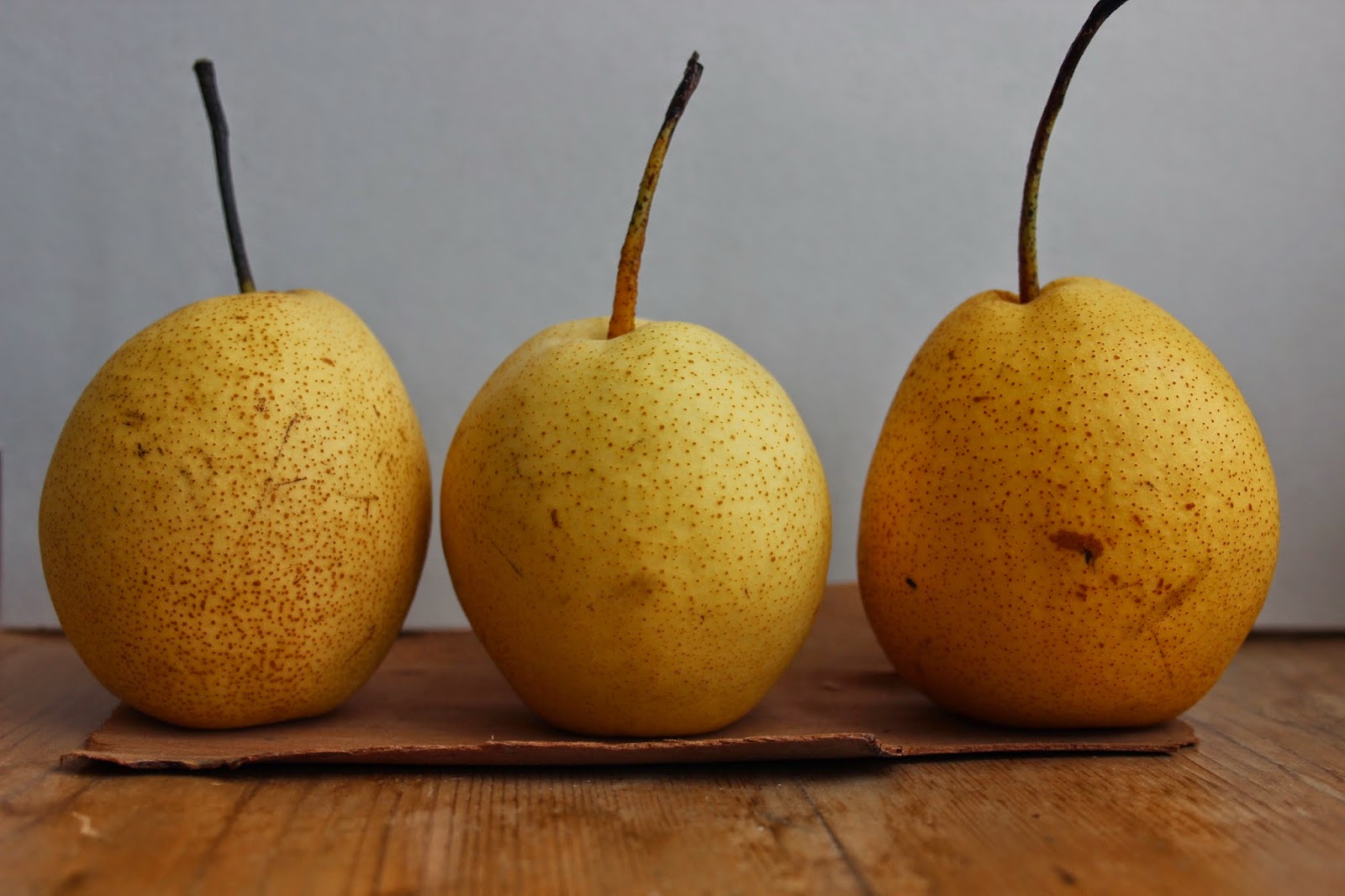
Asian pears, long distant cousins of European pears and crisp fleshed!

Here are some splendid examples of the latter, bought at a local supermarket. These are the Shandong variety of Asian pear were grown in China, and come regrettably with a carbon footprint. But what a fine pair, and one to spare!

In Asia, the culture of pear goes back 2500–3000 years and has been chronicled in Chinese writings from at least 1200 years ago. Pear was long considered a delicacy for the wealthy, along with the peach and apricot.

The precise origin of the European pear is still unknown but it has been with us since prehistoric times and dried slices have been unearthed in Swiss cave dwellings of the Ice Age.

A popular fruit of Medieval and Renaissance (Tudor in England) times pears were used much as a vegetable to add bulk, texture and to sweeten to pottages, stews, sauces for meats and fillings for pies. Pies such as this 12th scale dollshouse miniature made by MedievalMorsels.
Pears, which generally needed to be cooked, were used just like vegetables in Medieval, Tudor pies!

Cross pollination between orchard grown and wild pears was easy, so there was a viable, long-lived (up to 300 years for an individual pear tree) naturalised wild stock producing pears. Meaning there were plenty to go around in season, even in a peasant home. But there was a drawback!  These pears had to be cooked. Poaching in sweet red wine was a favourite dish for the nobility. I had a go at this dish during the Richard III re-interment and reburial celebrations, but I did not have good light to photograph the end result by!

Pears in wine with spices including cinnamon sticks, made by me!


According to expert Jim Chapman, Harris fruiterer to Henry VIII, introduced a wide range of dessert pears which did not need cooking from France and the Low Countries in 1533.  That made life easier then! But research indicates that the Romans probably introduced the original, hard cultivated pear to Britain, where the wild pear already existed. After the Romans left, in Anglo-Saxon times a pear tree was one of the six most common trees cited as boundary markers. I think that is a lovely thought! And the spread of the monastic movement throughout Europe, including Britain, ensured that Roman knowledge of pear culture was not forgotten. Hooray!


Tuesday, 28 April 2015

You've got the plague!

Mixed grain breads at dolls house 12th scale by MedievalMorsels

I was sitting outside last week. Spring has really sprung now, here in southern England.

My father used to partially quote, or misquote, a poem
"Spring is sprung,
the grass is ris!"
This nonsense poem has more lines. About birds and wings and things. But being of a then very tender age, I do not remember him reciting more, although he probably completed the poem. (He also liked to quote "Hiawatha" by Longfellow). Should you need to know, the above lines are attributed to one or other of: the English nonsense verse writer E.E. Cummings or the American poet Ogden Nash. But in reality we probably must put them down to Anon!

Anyway, I was sitting outside "distressing" some dollhouse wooden bowls and plates. Children were running home from school and I heard some words that suddenly brought back memories because, in my obviously uncaring youth, I had often uttered them too. I bet you did as well. And, what is more I bet millions of children across Europe have shouted this taunt for more than 100 years now, even though it references go even further back to Medieval times. Tell me, did your school playground taunts and tag games involve this now overheard and very mean-spirited slur?

 "You've got the Plague! You've got the Plague!"

The Black Death, the most virulent of a series of outbreaks of the bubonic plague, killed a massive proportion of the Medieval population across Europe during the years 1348-1350. In England alone it killed nearly a third of the population, and London's population was halved. The pestilence followed all of the trade routes to every country, carried by fleas on rats. It was believed to have originated in the Gobi Desert.  I really didn't know that. I thought it came to England, London probably, on ships from Norway. And perhaps it did! 
 
Malnutrition in England, due to bad weather conditions and consecutive failed harvests, was a reason why so many people sucombed to this malaise so easily. Death was swift, so you could say that a taunt that you had the plague was particularly cruel! Chances are though, that the taunter would have be incubating the dreaded disease as well! 


More one inch miniature food -bread- as featured in Wolf Hall by MedievalMorsels

 Wheat and other failed cereal crops either could not germinate or were flooded or blown down by driving rain. This meant a shortage of cereal meal thickening for pottages and for making bread. 
 And limited availability for pastry "coffyns", such a Medieval favourite.
A small chewetty or pie by MedievalMorsels
Fancy table pie with minced meats and fruits, spices


Root vegetables and beans rotted in the fields.

12th scale onions grown by MedievalMorsels

Organic dollhouse vegetables, cabbages by MedievalMorsels
In England the population drop following the Plague resulted in a higher value being placed on labour - the Peasants Revolt followed in 1381 challenging young King Richard II's authority. He, incidentally, grew to be a thoroughly disliked monarch, which is saying something by English Medieval and Tudor standards!

But farming and life for a peasant changed in the years after the Great Plague. The wool industry boomed. Less land was worked because previous levels of food production were no longer needed. They were less mouths to feed! The canny tenant Lord looked to save his money so indentured peasant labourer lost out to the more profitable woolly coated sheep. Many medieval hamlets and villages, devastated by Plague in the first place, were now abandoned as land-use changed and the less viable countryside could no longer sustain a working population.

Plague was to return many times in Europe and England. The Great Plague of 1665 brought death on a massive scale once again. A late as 1900 Australia and Portugal had outbreaks of bubonic plague.

MedievalMorsels is now on FaceBook! Please visit and @like@ if you can! 

Thursday, 23 April 2015

April 23rd is St George's day

Google reminded me this morning 23 April that it is St George's day, patron saint of England. Shakespeare was also born on 23 April, in 1564 and he died on the same day in 1616.
St George, probably born in Turkey, never set foot in England
St George is always depicted as a warrior knight of a saint, slaying a dragon whilst variously rescuing a maiden into the bargain. His emblem, a red cross on a white background, came to be adopted in the 12th century by England’s medieval king Richard I also known as Richard The Lion Heart. England’s medieval knights wore the cross on their tunics over chain mail to avoid confusion in battle. Richard, a French speaking king of England, was so fond of picking quarrels and fighting wars that he spent precious few months of his life ruling in the country.
Richard I (The Lionheart) an absent King medieval King of England


In fact Richard left sheriffs, his mother and his brother John to do that, and therein lies folklore surrounding a certain “Robin Hood”. And, reknowned warrior knight that he was, he did spend a considerable period captured and held to ransom! A bit of a disaster for England if the truth be known.

England came to adopt St George sometime later when he replaced St Edmund the Martyr as England’s patron saint in the 14th century. St George is patron saint of many other regions and countries including Aragon, Catalonia, England, Ethiopia, Georgia, Greece, Lithuania, Palestine, Portugal, and Russia and of many cities. He is also patron saint of scouts, soldiers, archers, cavalry and chivalry, farmers and field workers, riders and saddlers, and he helps those suffering from leprosy, plague and syphilis. So that was quite handy in medieval times!

Those medieval knights and nobles returning from far off lands did English cookery a big favour though.They brought back, and arranged trade in, many spices and new fruits and vegetables from the Near and Middle East, some with origins much further afield in China and India. The much loved tradition of adding sweet and warming spices to minced meat pies took off. And MedievalMorsels models’ listing notes reflect this.
One inch dollshouse food, Medieval or Tudor pie

Ornate pie with sweet and spicey meat filling, handmade 12th scale period dollhouse food
MedievalMorsels is now on FaceBook! Please visit and @like@ if you can!


Friday, 17 April 2015

Never buy a pig in a poke

A couple of things have piqued my interest about pigs (hogs, swine if you prefer) lately.  Two newly discovered facts which I will share below, and a custom order got me eventually modelling ham legs instead of just dreaming about doing this. So, all in all, I have been prompted to post about pigs!
A dollshouse miniature ham, one inch scale, perfect for a period dollshouse pantry

Hams away! 1:12 scale dollhouse miniature food by MedievalMorsels

Delicate trotters on a 12th scale leg of ham from a medieval forest pig
And here is my ham plus some black puddings and red herrings hanging in client Linda's beautiful 1550 Tudor dollshouse setting at her home in Lichfield, a noted medieval city.
A close up of Linda's wonderful dollshouse period kitchen of 1550

The one inch scale Tudor dollhouse kitchen in all its glory


A short while ago I was idly flicking through the TV channels when I accidentally paused on some channel, but with my laptop engaging my full attention. I was alerted when I heard the narrator exclaim about pigs wearing pokes. My interest was immediately aroused, I have always wondered what a pig in a poke really is. On the screen was old anthropological film footage in black and white, taken in Indonesia I think, and I saw were three cute long legged pigs running about on the edge of some scrub forest. They were wearing something around their necks and this gave them a rather comical air.


One of my first clients in San Francisco, brought up in the country but now living in the city, said that she had been taught never to buy a pig in a poke. (We were probably talking about customised orders of dolls house scale model food!) This is a common saying on both sides of the Atlantic. One that we use a lot today in my experience, after all we all like to get good value when parting with hard earned money.

 A pig in a poke is an offer or deal that is foolishly accepted without being examined first. When researching period foods I had also come across the many centuries old advice to never buy a pig in a sack, or a bag. Useful advice indeed because if you aim to buy a suckling pig at your town market you don’t want to be sold a butchered cat or pup instead. Related terms are “sold a pup” and “ let the cat out of the bag”. My oh my! This gets more and more interesting etymologically speaking, but a little gruesome...


So I promised my client that I would find out about the expression when I modelled new pork, ham and bacon products for MedievalMorsels’ dolls house miniature food range. Well okay, I admit that was quite a long time ago and so far I have only modelled whole hams from the ancient foraging forest pig. 
In this medieval woodcut pigs are enjoying the fruits of the forest - autumn acorns!


The other pig item that caught my attention was a trailer for a BBC radio programme yet to be broadcast about local and regional foods. One programme was/is to be about the Tamworth pig and, presumably, Wiltshire ham. The food expert was saying the Tamworth pig is about the closest domesticated breed we have to the ancient forest pig, so my ears pricked up at this. I am looking forward to hearing that particular porcine programme!


Almost 20 years ago in 1998 two Tamworth pigs escaped from an abattoir in Wiltshire, breaking through a fence and swimming across the River Avon to leg it to freedom. The Tamworth Two, as they became known, quickly became more famous than notorious escaped criminals. They were spotted on and off by a now pursuant international press pack, enjoying their freedom and neatly evading their own capture whilst simultaneously capturing the world’s attention. This was the before the days of You Tube phenomena, but you could say they had gone viral! These enterprising and intelligent porcine siblings were photogenic too, with lots of ginger hair and delicate snout, body and limbs.

Endearing and intelligent, pigs have it all.


So was a poke  another type of sack or bag? Armed with real anthropological evidence about free range pig rearing practice it seemed as though today’s meaning had got removed from an original piggy use of the word “poke”.  This poke was a sort of necklace, if you will, for a female pig and a collar, if you prefer, for a male pig. The poke was made of three long robust sticks tied together around the pig's neck in a widely overlapping triangle. A perfect remedy to prevent your pigs roaming into dense scrub land or away from the forest clearing.


And the Tamworth Two? Well their story ended happily. Aged only six months when they escaped Sundance, the Tamworth boar and with his sister Butch (geddit?) enjoyed a week on the run scavenging in the back gardens of locals. I expect they were only too pleased, assuming all the potentially prize-winning vegetables were on the allotment. 
They were captured, bought and sponsored by a daily newspaper and re-homed in luxury at a Rare Breeds Centre in Kent, where they attracted many visitors. In 2004 the BBC even made a drama about them. They died at the ages of 13 and 14 respectively. It turns out that these wily pigs were actually Tamworth and wild boar cross-breeds, which may account for their innate ability to outwit their handlers and pursuers chasing them for a full week around Malmesbury in rural Wiltshire.

The future of Butch (left) and Sundance (right) was secured by the Daily Mail newspaper


And the thing is if they had been wearing pokes they would not have escaped at all! 

But...to return to the saying "never buy a pig in a poke". A poke is also a Middle English word for a small sack or bag, and there are similar words in many old northern European languages. So we are back to our first presumed interpretation of the old saying. The anthropological interlude with collars was, in reality, a porcine "red herring"!
Preserved red herring, 12th scale dollhouse miniature food beloved of Medieval, Tudor and Renaissance diners

How about the meaning of the word cowpoke anyone? Sure, it a colloquial term for a cowboy. But in times gone by the practice of using a forked branch as a collar poke was a sure way to keep foraging cattle in the enclosure or close to the settlement.

MedievalMorsels is now on FaceBook! Please visit and "like" if you can!