Tuesday, 15 September 2015

The Isle of Ely, or Eeley?

A recent edition of the "Kitchen Cabinet" on BBC Radio Four came from Ely, often referred to by locals as "The Isle of Ely".  This small city In Cambridgeshire is not so very far from where I grew up as a child.  So, of course, I was very interested in the programme.

The Isle of Ely is so-called because in the Dark and Middle Ages, and in later times too, it stood elevated literally as an island. Topographically the land that was settled lies a little higher than the surrounding marshland of "The Fens" which, to this day, lie below sea-level. 

Earliest school history lessons had taught me about heroic Hereward the Wake, who hailed from The Fens and hunkered down in Ely. He  fought successful skirmishes with the Normans invaders for as long as he could, effectively he was a guerilla fighter, using the marshes to cover his tracks. Quite literally! We were told in the programme by a local historian that the Normans resolved to lay siege to the Isle of Ely and starve him and his supporters into submission.
MedievalMorsels' tubs of live wriggling eels for a period dollhouse, one inch scale

Buckets of 12th scale eels for a Tudor, medieval dollshouse
Which brings me to a second point. Ely is a strange name, there is no doubt, and it is so similar to the word eel. It really does reflect the fact that Eels were abundant in those Fenland marshes. In fact, Ely paid its taxes to the reigning Medieval monarchs by way of barrels of eels! Revenue from the sale of eels, we were told in the radio programme, paid for the building of the very impressive Medieval Cathedral, and much more besides. 
Eels for a 1:12 dolls house kitchen scene, miniature food by MedievalMorsels
But the process of laying siege and starving the inhabitants of Ely into submission must have been a protracted one - after all I am sure the locals knew a hundred or more ways to catch and cook eels. Rather like the Portuguese and the 365 dishes they can cook with their national fish - bacalhau, salted cod.

But back to the eels. MedievalMorsels models eels in wooden tubs. Ideal for the one inch scale Medieval or Tudor period dolls house kitchen or storeroom. Many of my clients say how ugly they are - I think the mean the eels not the models thereof! Judge for yourself. Is it because my eels are just too realistic? And eels do resemble snakes which can trigger a primeval fear in some. Or is it that we instinctively realise eels are just too slithery and therfore difficult to prepare for the pot? And to modern tastes, are they fatty and unpalatable even after all that effort? 
What would you do if you met these eels and their catfish friend modelled by MedievalMorsels?

Well if so, how about salted cod instead? MedievalMorsels can oblige on that score too!

MedievalMorsels makes 12th scale salted cod for you period dolls house kitchen scene

I have swum three quarters of a mile in a swimming race in the River Great Ouse at Ely. Well it was a long time ago, I was 13 years old. My worry then was not eels, I did not think of that!  My worry, because my friend Linda Plowright and I had been teased about it by the older swimmers, was pike hiding in the shadows under the bridges! I recall that I tried to swim under the bridges, and past trees which cast scary shadows on the river surface, as fast as I could! After all the Great Ouse is a wide, muddy  river - full of Fenland silt and clay - where you have no chance of knowing what is going on beneath the surface!

Thursday, 10 September 2015

Pie bakes

MedievalMorsels has been experimenting with different styles of Dark Ages, Middle Ages and later periods of table pie for a period dolls house. Some pretty ornate,  which could serve as a centrepiece on a feast table, and others that would serve as a table pie in a rich merchant or a noble's home.
1:12 scale pies with gilded cross by MedievalMorsels

Medieval, Tudor pies for a dollhouse feast centrepiece!
One inch dollshouse food, pies!


MedievalMorsels' leaf decorated Georgian, Tudor pies


On the very popular BBC TV programme "Great British Bake Off" this week, week five, the competition revolved around pastry making challenges - a franzipan tart, flakey pastry vol au vents and a Cypriot speciality cheese pastry parcel. 

But the historical interlude during the c programme  focused on Denby Dale in Yorkshire, which holds the Guinness Book of Records world record for the largest meat and potato pie. The world beating pie was baked in 1988 to celebrate the passage of 200 years since the C18th, when Denby Dale's first giant pie was baked in 1788. Incidentally that was to celebrate the recovery of King George III from his mental illness. And it was that George who "oversaw" England's loss of colonies in the North America. So we can sumise that around the same time that an important War of Independence was raging in the "New World", on the other side of the Atlantic Ocean in the "Old World" giant pies were planned and baked! Conjure with that if you will!

Denby Dale also a baked behemoth pie in 1846 to celebrate the repeal of the Corn Laws, which heavily taxed the price of grain. That pie was eight feet in diameter, a veritable giant for its day. Apparently the Master of Ceremonies fell into it!

In 1877, this time to celebrate Queen Victoria's 60 years Golden Jubilee on the throne, another pie was baked. But this one went sour and had to be hastily buried in quicklime. I can imagine it held quite a few carcasses worth of meat -  yuk, smelly! 

Luck was not with the Denby Dale community in 1928 when their bumper pie got stuck in the brick oven. There was more success in 1964 when the   monster pie fed 30,000 people. 

Which of MedievalMorsels' mini pies at 12th scale is a winner for you?

Pastry leaf decorated 12th scale pie
One inch scale dolls house Medieval, Tudor pies
MedievalMorsels celebrates with hand raised pies


Thursday, 3 September 2015

Bringing in the beans!

12th scale fava beans
12th scale dollhouse miniature food by MedievaMorsels, beans!


MedievalMorsels had a bit of fun modelling one inch beans for the period or modern dollshouse kitchen last week! The results were quite colourful and have, I am pleased to say, met with some approval from the miniaturist community!

MedievalMorsels' one inch scale bowls and tubs of beans
The bean cycle according to MedievalMorsels, dollhouse miniature food
Dried lentils and other peas, beans or "pulses" have a long tradition in mankind's food history. Neolithic ancestors of modern man ate them, and so did the ancient Greeks. 

And from literary sources, the Old Testament , we are told that Esau came in from his fields so weary and hungry that he sold his twin brother his birthright for "red pottage....of lentils." 
 
The Romans so prized pulses that they appear as ancient family names - fabius (broad bean), lenticulus (lentil),  or cicero (chickpea). Who, except a student of language, would have believed this? 

Tudor dollhouse food, 12th scale fava beans for a dollshouse kitchen scene


Tuesday, 28 July 2015

Ground Almond soup, could this have been a medieval favourite?

Following my post yesterday on Spanish hams and their Medieval ancestry I have discovered something even more exciting in terms of its Medieval food heritage. And all whilst enjoying my holiday here in Gibraltar. Staring at me from a chilled foods counter in the "Eroski" supermarket was ground almond soup! Intended, like its cousin vegetable gazpacho soup, to be eaten cold this thick pureed concoction is made with very few, but all natural ingredients. 

The ingredients of "El gazpacho de almendras ajoblanco" , an obviously still popular dish from rustic Andalusia, are (and I am testing my abilities to read Spanish here): water, almonds, lemon juice, virgin olive oil, ground bread, vinegar wine, salt, and garlic. And all are staples from Medieval days too...cooks then  were fond of ground breadcrumbs as a thickening agent. 

I am a little surprised the soup has only 7% almonds - now I am a little less excited since I thought it was almost purely an almond milk concoction! Certainly in Medieval times water would not have been added to the mix unless the whole batch was to be boiled.

Here is my discovery, in a Tetrapak of course. Its not a dish I shall be replicating for the Medieval or Tudor dollshouse though. I think it lacks a little presence!

Almonds were a very versatile cooking ingredients whose flavours was much appreciated by the medieval palate. They were put to many uses in both sweet and savoury dishes, certainly they were very important in Medieval cookery. Almond milk was used in the range of “white food” or blancmange dishes incorporating shredded white meat or fish. Used with eggs or butter and various flavourings it made sauces that counteracted the excessive saltiness or smokiness of preserved meat or fish. Fried whole almonds were popular as a garnish for many dishes.

Cultivation of almonds, which are related to apricots and cherries, goes back into pre-history. The food historian Alan Davidson notes that today the almond is actually the most important commercially produced nut. It was introduced to Europe from Asia, via Spain, by the Phoenicians in the 8th century. Well, here in Gibraltar at the southern tip of Europe, and surrounded on three sides by Spain, those trading Phonecians did came calling and they settled awhile leaving archaeological evidence, including fine glassware for which they were reknowned 

"El gazpacho de almendras ajoblanco" is starting to make historic and geographic sense now. My excitement levels are rising once more. And I have not even tried the chilled soup yet, maybe tomorrow for lunch...


Monday, 27 July 2015

Cured hams - an Iberican speciality

Whether you are a vegetarian or not, whilst in a bar or market cafe in Southern Spain you can’t help but notice the legs of ham hanging above you. Well I can’t anyway, with my  eager “modern medieval food” eyes wide open. Some hams, I notice, have white trotters and some, producing the superior quality “pata negra”, have black trotters - or at least black toes.


And then there are stacks of hams in the supermarkets all year round. In years gone by you might only have seen them in the supermarkets in the run up to Christmas, but why not celebrate any special occasion with “jamon serrano”?


Curing a hog’s leg with salt goes back to time immemorial. Cato the elder wrote over 2000 years ago in  “De agri cultura”  “On farming” as follows: “Spread salt in bottom of (my edit: very large!) jar, lay a ham cover with salt, lay another meat not touching, cover with salt. After five days, remove and reverse order hams are placed in. 12 days later remove hams, brush off salt, hang in a draught for 2 days. On the 3rd day clean with sponge and rub with oil (my edit: olive oil of course). Hang in smoke for 2 days. On the 3rd day take them down, rub in a mixture of oil and vinegar, hang in the meat house. No moths or worms will touch them.”


This method of curing the larger cuts of meat from swine (hogs, pigs) changed very little in 2000 years in today’s artisanal ham making - except the time allowed for curing is much longer - up to two years for a jamon serrano and up to 4 years for a jamon iberico. The curing process alters the flavour and the natural enzymes have longer to break down the tissues and make the ham mouth wateringly tender. Patience is rewarded!


History bears witness that the pig (hog or swine) produces the world's best tasting flesh, it is the only animal where a specific vocabulary has developed for its different meats - namely pork, ham and bacon. Pig meat of all three types was highly valued by all classes of Medieval society, and it was no exaggeration to say that every part of the animal was eaten. MedievalMorsels models ham legs and ham sides at 12th scale for your period or contemporary dollshouse, roombox or diorama. My online shop re-opens on 1 August after a short holiday break. take a look then!

The pig (Sus scrofa domesticus) is the oldest domesticated creature besides the dog. All pigs are descended from the wild boar (Sus scrofa). Bones from Turkey show human/pig association as early as 8000 BC, pre-dating man's cultivation of barley and wheat. This seems to disprove the commonly held theories first, that goats and sheep were the first domesticated animals and second, that man engaged in crop growing before animal husbandry. Pigs were, however, domesticated at different times around the world.

Tuesday, 23 June 2015

Wimbledon, Hampton Court, Henry VIII and strawberries - anyone for tennis?

Silver server of strawberries, fit for Tudor formal dining or served alongside a Real Tennis court!

Wimbledon fortnight is upon us and the world’s attention is centred on that court, the aptly named Centre Court. And yet Wimbledon’s illustrious All England Lawn Tennis and Croquet Club, to give it its current full title, owes its existence to a much earlier adopter of the sport of tennis in England. That game changer was no less than the 6ft 4inches, athletic, young King Henry VIII.


So not a million miles away from SW1, in fact less than ten miles distant, it is another other tennis court that fascinates. Henry was an enthusiastic proponent of the game of “real tennis”, a worthwhile pursuit among the noble class that was designed to  “...chase idleness , virtue’s mortal enemy…”. After playing on the indoor court at Hampton Court Palace- for it was an indoor game - how would Henry have refreshed himself after vanquishing all the finest players in his noble entourage?

One inch dolls house fruit, handmade strawberries for Medieval, Tudor, Regency luxury dining


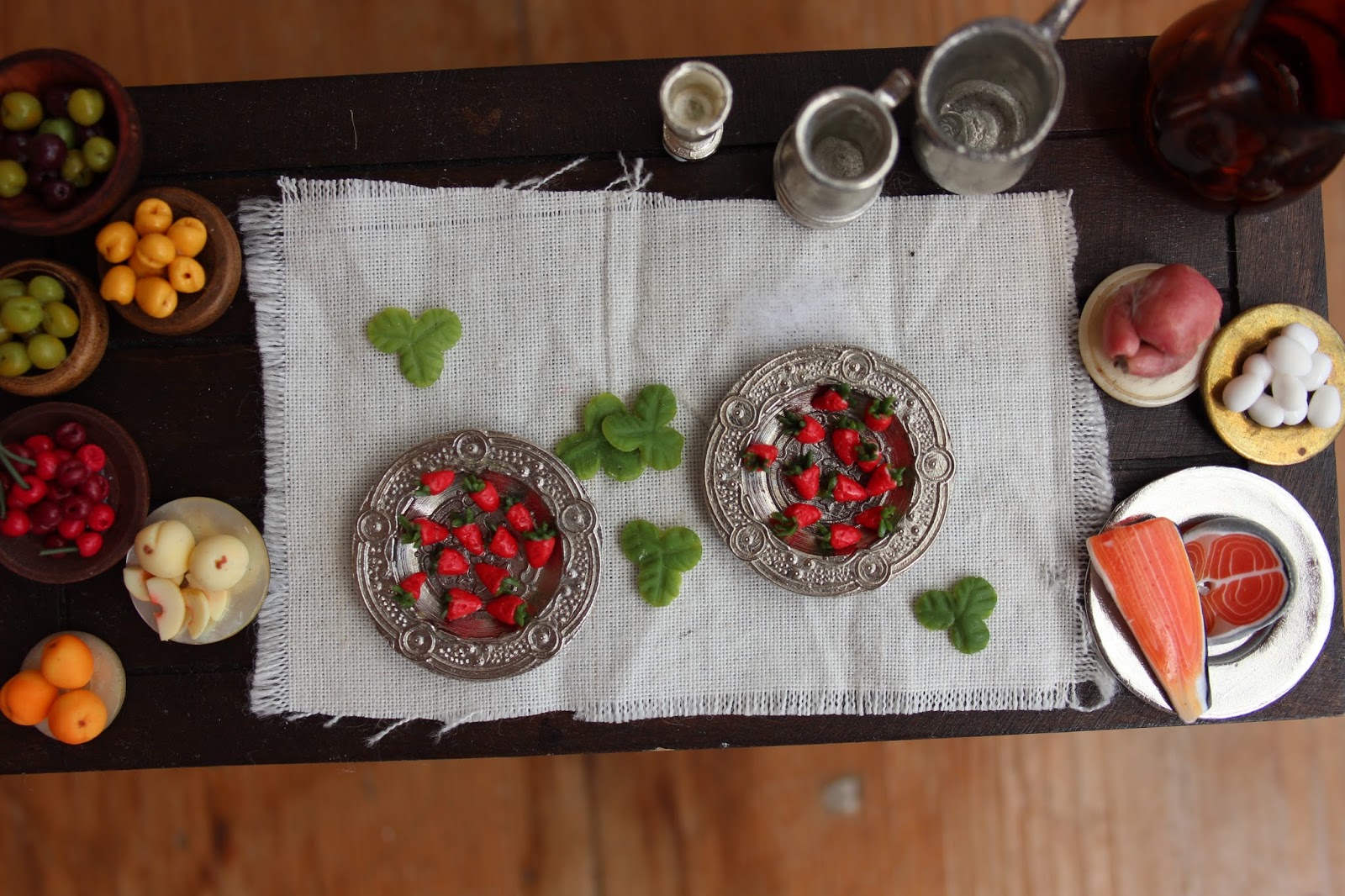
Why, with some strawberries of course! MedievalMorsels has modelled the very same and arranged the trophy fruit on an ornate plate resembling the Ladies allcomers challenge trophy. Strawberries were a tricky plant from which to grow fruits in any quantity or size. Probably Tudor strawberries were no bigger than today’s wild Alpine strawberries. But other delicious garden summer fruits would make a thirst quenching and natural sugar laden post-set snack. Henry would have uppermost on his mind the exotic varieties of cherries, peaches, plums and apricots - all carefully tended by his gardeners, grown from new varieties imported from the Low Countries (Belgium and Flanders) and Italy in particular. And MedievalMorsels takes pleasure in modelling these too.


Dollshouse miniature food, summer cherries at 1:12 scale from MedievalMorsels

Twelfth scale peaches for a period dolls house, miniature dollhouse fruit by MedievalMorsels
One inch scale dollhouse fruit, plums of all types for a Medieval, Tudor or modern rustic dining scene


It was Cardinal Wolsey who actually built Hampton Court Palace with its real tennis court. But he had not long been in possession of it than he was rapidly falling out of royal favour. He had still failed to secure a Papal anulment for Henry’s 26 year marriage to his brother’s widow, Katherine of Aragon. With no male heir Henry planned, of course, to marry Anne Boleyn. Wolsey made Henry a present of Hampton Court, which he had built between 1526 -1529.


Fast forward just a few years and it is said, on Hampton Court Palace’s website no less, that Henry’s second wife - Anne Boleyn - was gambling on a game of (real) tennis when she was arrested to be taken to the Tower of London. She even complained that she couldn’t collect her winnings! Whether we are really to believe this I cannot say...


Although it looks like a strange combination of tennis and squash, according to The Royal Tennis Club “the techniques, strategies and rules are more complex than for the modern derivatives”. Each ball contains a core wrapped around with some thirteen yards of webbing in half inch widths, and in fact many balls in use today started their life over a century ago but have been re-covered! The tennis racquets are usually made from hickory or ash with sheep gut still commonly used for the strings. The curious shape of the head of the racquet is designed to help the player to cut the ball by having a large area of strings across which a ball can sweep diagonally. By contrast today’s lawn tennis players employ top-spin.


Real tennis is the original indoor racquet sport from which the modern game of tennis is descended. It only acquired its ‘real’ tag at the end of the 19th century to distinguish it from the new-fangled ‘lawn’ tennis. The number of real courts has actually risen in the last thirty years. There are now 27 in Britain, 10 in the USA, 3 in France and 6 in Australia. Despite there being no more than a few thousand real tennis players in the world, they make up in keeness for any lack in numbers, organising professional and amateur tournaments practically all year round.


“The Club”  that has given rise to the current Wimbledon tournament however was founded some three centuries later in 23 July 1868 but at the height of a croquet craze! The then-infant sport of Lawn Tennis was introduced in 1875, when one lawn was set aside. The first tennis Gentlemen's Championship in Singles was held in July 1877. Wimbledon’s present Centre Court, built in 1922 upon the move of the Club, was not actually in the centre at the time it was built, but it is so now. British viewers will be eager to follow Andy Murray’s progress especially as he has just won a grass warm-up tournament at Queens for a record fourth time, but lets hope all the ‘great’ players, newcomers, ‘wild cards’ and  underdogs alike have a splendid Wimbledon this year. Some of my favourite players have been Arthur Ashe, Ilie Nastase, John McEnroe and Miloslav Mečíř - players of touch before the advent of the power game, double handed backhands and power racquets (do I mean rackets?).  


With its retractable roof and flood lighting, modern Centre Court is equipped to deal with rain and the failing light of late running matches - remember there is no tie-break in a final set at Wimbledon! Rain never posed a problem for real tennis players, the grilled window in one wall, through which light, but not rain poured, was a featured “hazard” attracting penalties if you hit it. Now if anyone can explain real tennis in simple terms, I’d be surprised. Cambridge University Real Tennis club describes it thus “...subtlety and thought are more prized than power and fitness. It is played in an asymmetrical court which contains many unusual features, sloping roofs, openings (galleries) in the walls and a main wall which has a kink in it (tambour) so the ball on hitting the sloping face moves across the court instead of continuing down the line of the main wall. It has the classic elements of warfare where a failed attack is punished by a counter-attack.”

Saturday, 13 June 2015

Magna Carta, Bad King John and Lampreys

A dish of lampreys fit for a King or Queen, 12th scale period dollhouse food by MedievalMorsels
June 15 th 2015 is the 800th anniversary of Magna Carta! That is to say the anniversary of King John agreeing to attach his Royal Seal to the historic document. To be honest, the term Magna Carta (great charter) may be more significant to your average American than your average Brit. But I suspect there will be plenty of media attention in the UK and perhaps we will trawl up memories of mostly forgotten history lessons….What’s the fuss, was King John really so bad and why might our American cousins be more enamoured of this anniversary than we can truthfully  admit? And what on earth do lampreys have to do with it?
King John and his second wife Queen Isabella by Angeliqueminiatures, about to set upon their lamprey feast!

A lattice pie by MedievalMorsels filled with John's favourite food, lampreys! Medieval dollshouse one . food
King John was not a good man, not at least according to A A Milne (he of Winnie-the-Pooh fame) in his poem written in 1927. In this enchanting verse we grow to feel sorry for King John as he anticipates no presents again in his stocking at Christmas! Whilst all the time he  really does want a big, red,  India rubber ball. Charming and anachronistic, I had a copy of Milne’s poetry anthology “Now We are Six” on a suitable birthday! Why did people revile him?
England's crown passed to "bad" King John (1167-1216) on the death of his brother, Richard so-called Lionheart. John had  earlier tried to “usurp” the crown while Richard was away doing what he liked best, fighting battles overseas. So he wasn’t trustworthy then. The mighty Barons of England’s shires saw that John abused his power as monarch. Through his outrageous behaviour John had managed simultaneously to alienate all three orders of Medieval society in his realm. First, the powerful nobility - the barons and lesser nobles. Second, the Church - for six years of his rule the Pope ordered churches to be closed and finally he excommunicated John. And last, the remaining 90% of the population, John’s unfair rulings had alienated the peasants. Exasperated the Barons took London and invited Prince Louis, heir apparent to the King of France, to rule England. John was at Windsor Castle and both factions met at Runnymeade on the River Thames to negotiate terms. Such was their mistrust,  the Barons were not going to let him leave without signing. On 19 June 1215, with the Seal presumably affixed by court officials, the Barons then finally swore their allegiance to John.

 Louise Goldsborough Bird creates historically accurate 12th scale dolls, MedievalMorsels can supply their favourite foods!
Magna Carta was without precedent, drawn up to protect all “free” men by calling on the law, and fair judgement by equals (a jury as we would now say). And no longer to be subject to the whim of the power crazed, autocratic and selfish King John. Clause 39 states that “No free man is to be arrested, or imprisoned, or disseised, or outlawed, or exiled, or in any other way ruined, nor will we go against him or send against him, except by the lawful judgment of his peers or by the law of the land.”  The "villeins" or unfree tenants were excluded, technically they fell within the jurisdiction of their lords.
In essence most of Magna Carta’s 63 clauses granted by King John, under duress he would later argue, dealt with specific grievances relating to his rule. The Barons sought to make the despotic King John subject to the law of the land, but within three months of attaching his seal John petitioned the Pope for its anulment. After John’s premature death however the Baron’s swiftly resurrected an updated Magna Carta. Although nearly a third of the text was deleted or substantially rewritten within ten years, and almost all the clauses have been repealed in modern times, Magna Carta remains a cornerstone of the British constitution. Some of Magna Carta’s core principles, Clause 39 in particular, are echoed in the United States Bill of Rights (1791) and in many other constitutional documents around the world, as well as in the Universal Declaration of Human Rights (1948) and the European Convention on Human Rights (1950).  


The same King John loved to eat lampreys, eel like fish which happened to be a favourite dish of earlier  English Royal courts. Some centuries before, King Henry I (1068-1135) was also known for his lust of eating them, reportedly dying from a "surfeit of lampreys" as one chronicler elegantly put it. This befell that particular monarch on a hunting trip to France and since, like most early  English monarchs, Henry was really more French than English perhaps a gastronomic death in France was fitting! Most historians believe that he died from food poisoning, but quite possibly it was the lampreys "wot did it ".

Well, the same fate befell quite plausibly befell King John. Soon after learning his baggage “train” and its treasure including his crown jewels were lost in the Fenland marshes he too sucumbed to food or some other more sinister poisoning, dying at Newark Castle. Whether his last meal included the exceptionally fatty and highly indigestible lamprey Medieval chroniclers do not say, but I imagine they were easy to trap in the marshes and we know that he often called ahead for such a dish of lampreys to be prepared and even brought out to meet him as he approached a town on his "Royal Progress".
So great was the demand for lampreys during his reign, that John issued a mandate to the sheriffs of Gloucester, where the best were to be found, forbidding the first lampreys of the season to be sold for any more than two shillings a piece. This sounds very expensive indeed! According to the Royal Cookbook, King John also levied a fine of 40 marks (a mark was about two third of a pound) on the city of Gloucester for failing to "pay him sufficient respect in the matter of his lampern." Perhaps they had forgotten him at Christmas?! Or to send a lamprey pie to meet him at the city gate. Embarrassing because his first wife, before acceding to the throne, was Isabella of Gloucester. Perhaps the bad temper levelled at Gloucester really arose because he wanted to divorce her for a younger bride now he was to be King Notably the very beautiful and much younger Isabella Countess of Angouleme, France.
Queen Isabella, Countess of Angouleme, may not have shared her husband's enthusiasm for lampreys

Unlike other fish, the lamprey has no scales, jaws, gill covers or bony skeleton. Fossil evidence has shown lampreys date from before dinosaurs, evolving some 250 million years ago and belonging to a near-extinct family of jawless fishes. So now for some unpalatable natural history about the ancient sea lamprey (Petromyzon marinus). A lamprey's downward slanting mouth consists of a large, tooth-lined sucking disc. Once it has latched onto the side of another fish, the lamprey opens a hole in its host by wiping its raspy tongue across the skin. The parasite (because that is what a lamprey is!) then secretes an anticoagulant that keeps this wound open so that the lamprey can feed on the prey's blood and tissue.