Friday, 17 April 2015

Never buy a pig in a poke

A couple of things have piqued my interest about pigs (hogs, swine if you prefer) lately.  Two newly discovered facts which I will share below, and a custom order got me eventually modelling ham legs instead of just dreaming about doing this. So, all in all, I have been prompted to post about pigs!
A dollshouse miniature ham, one inch scale, perfect for a period dollshouse pantry

Hams away! 1:12 scale dollhouse miniature food by MedievalMorsels

Delicate trotters on a 12th scale leg of ham from a medieval forest pig
And here is my ham plus some black puddings and red herrings hanging in client Linda's beautiful 1550 Tudor dollshouse setting at her home in Lichfield, a noted medieval city.
A close up of Linda's wonderful dollshouse period kitchen of 1550

The one inch scale Tudor dollhouse kitchen in all its glory


A short while ago I was idly flicking through the TV channels when I accidentally paused on some channel, but with my laptop engaging my full attention. I was alerted when I heard the narrator exclaim about pigs wearing pokes. My interest was immediately aroused, I have always wondered what a pig in a poke really is. On the screen was old anthropological film footage in black and white, taken in Indonesia I think, and I saw were three cute long legged pigs running about on the edge of some scrub forest. They were wearing something around their necks and this gave them a rather comical air.


One of my first clients in San Francisco, brought up in the country but now living in the city, said that she had been taught never to buy a pig in a poke. (We were probably talking about customised orders of dolls house scale model food!) This is a common saying on both sides of the Atlantic. One that we use a lot today in my experience, after all we all like to get good value when parting with hard earned money.

 A pig in a poke is an offer or deal that is foolishly accepted without being examined first. When researching period foods I had also come across the many centuries old advice to never buy a pig in a sack, or a bag. Useful advice indeed because if you aim to buy a suckling pig at your town market you don’t want to be sold a butchered cat or pup instead. Related terms are “sold a pup” and “ let the cat out of the bag”. My oh my! This gets more and more interesting etymologically speaking, but a little gruesome...


So I promised my client that I would find out about the expression when I modelled new pork, ham and bacon products for MedievalMorsels’ dolls house miniature food range. Well okay, I admit that was quite a long time ago and so far I have only modelled whole hams from the ancient foraging forest pig. 
In this medieval woodcut pigs are enjoying the fruits of the forest - autumn acorns!


The other pig item that caught my attention was a trailer for a BBC radio programme yet to be broadcast about local and regional foods. One programme was/is to be about the Tamworth pig and, presumably, Wiltshire ham. The food expert was saying the Tamworth pig is about the closest domesticated breed we have to the ancient forest pig, so my ears pricked up at this. I am looking forward to hearing that particular porcine programme!


Almost 20 years ago in 1998 two Tamworth pigs escaped from an abattoir in Wiltshire, breaking through a fence and swimming across the River Avon to leg it to freedom. The Tamworth Two, as they became known, quickly became more famous than notorious escaped criminals. They were spotted on and off by a now pursuant international press pack, enjoying their freedom and neatly evading their own capture whilst simultaneously capturing the world’s attention. This was the before the days of You Tube phenomena, but you could say they had gone viral! These enterprising and intelligent porcine siblings were photogenic too, with lots of ginger hair and delicate snout, body and limbs.

Endearing and intelligent, pigs have it all.


So was a poke  another type of sack or bag? Armed with real anthropological evidence about free range pig rearing practice it seemed as though today’s meaning had got removed from an original piggy use of the word “poke”.  This poke was a sort of necklace, if you will, for a female pig and a collar, if you prefer, for a male pig. The poke was made of three long robust sticks tied together around the pig's neck in a widely overlapping triangle. A perfect remedy to prevent your pigs roaming into dense scrub land or away from the forest clearing.


And the Tamworth Two? Well their story ended happily. Aged only six months when they escaped Sundance, the Tamworth boar and with his sister Butch (geddit?) enjoyed a week on the run scavenging in the back gardens of locals. I expect they were only too pleased, assuming all the potentially prize-winning vegetables were on the allotment. 
They were captured, bought and sponsored by a daily newspaper and re-homed in luxury at a Rare Breeds Centre in Kent, where they attracted many visitors. In 2004 the BBC even made a drama about them. They died at the ages of 13 and 14 respectively. It turns out that these wily pigs were actually Tamworth and wild boar cross-breeds, which may account for their innate ability to outwit their handlers and pursuers chasing them for a full week around Malmesbury in rural Wiltshire.

The future of Butch (left) and Sundance (right) was secured by the Daily Mail newspaper


And the thing is if they had been wearing pokes they would not have escaped at all! 

But...to return to the saying "never buy a pig in a poke". A poke is also a Middle English word for a small sack or bag, and there are similar words in many old northern European languages. So we are back to our first presumed interpretation of the old saying. The anthropological interlude with collars was, in reality, a porcine "red herring"!
Preserved red herring, 12th scale dollhouse miniature food beloved of Medieval, Tudor and Renaissance diners

How about the meaning of the word cowpoke anyone? Sure, it a colloquial term for a cowboy. But in times gone by the practice of using a forked branch as a collar poke was a sure way to keep foraging cattle in the enclosure or close to the settlement.

MedievalMorsels is now on FaceBook! Please visit and "like" if you can! 

Saturday, 4 April 2015

Easter is here! Heralding Spring at last.

All of Medieval society looked forward to the end of winter, with Easter and springtime to follow and the promise of nature's new growth. For a peasant family the spring season meant new planting, new growth and, hopefully, newly grown tender shoots to help sustain a family that had run down its monotonous winter stock of pickled or salted vegetables. Yuk!

Tending the Medieval vegetable and herbe garden.

As well as plants such as spinach and lettuce grown as "sallette" or salad crops, the green tops of vegetables such as beets and radishes would have typically been eaten too. And there would have been wild leaves such as dandelion, sorrell, orache and young nettle leaves to forage for! 

Encouraged by a Ukrainian friend, I did once made a nettle soup having tasted hers. Made from the non-stinging variety of nettle and picked well away from the roadside and passing dogs I hasten to add. It tasted okay I suppose, and I do remember it was a pleasant bright spring green colour. 

 Here is MedievalMorsels' plate of salad leaves, miniature food for a one inch scale period or rustic dollshouse.

MedievalMorsels' period dollhouse one inch miniature food - a bowl of green salad


Medieval “dietetic law” stated that vegetables were a source of disease, especially if eaten raw. Onions, garlic, leeks and cabbage were believed to be an exception to this rule so long as they were cooked thoroughly. In fact the noble classes were advised by the physic (doctor) to “beware green sallettes”. 


Peasants would  not have any interest in such pronouncements by their learned "betters" and would in fact have grown herbes and vegetables behind their cottage, either for the pot or to eat raw. The manor and the monastery would have had a herbe garden too, for medicinal purposes at least.

Now traditionally it is also eggs at Easter time that symbolically represent re-birth.  Eggs were classified as meat by the church in Medieval Europe so could not be eaten during Lent, What could be done with surplus eggs then? Well, they were coated in liquid fat or wax and set aside to keep (hopefully) until Easter Sunday. Some were coloured using extracts from a range of roots, wild berries or herbs. 


A dish served by Thomas More in the BBC Tudor drama "Wolf Hall", based on Hilary Mantel's prize winning novel 


 But how about this for MedievalMorsels' Tudor dolls house dish, which happens to have been inspired by the BBC's dramatisation of Hilary Mantel's Wolf Hall. It combines both spring greens and eggs!

MedievalMorsels 1:12 scale dollhouse miniature food, spinach and eggs with plenty of bread and cheese


MedievalMorsels is now on FaceBook! Please visit and "like" if you can!

Tuesday, 31 March 2015

Richard III re-buried - white roses tell the tale

White roses really do tell a tale.
Beautiful embroidery of Richard's personal badges by members of Lord Burgh's Retinue 

Countless thousands turned out to past their last respects to Richard III whose mortal remains were finally laid to rest with dignity and honour in Leicester Cathedral, some 535 years after his first hasty burial in the chancel of the Greyfriars Priory church.


Leicester Cathedral had been re-ordered so that Richard’s tomb could be located in a similar position facing east, even as his cramped grave at Greyfriars had been. The cathedral was able to offer a thoughtful service closely modelled on a newly discovered description of an actual medieval re-interment. A service that Richard was probably familiar with, since the re-discovered manuscript related to the re-interment of his wife Anne Neville’s grandfather.  


The present Archbishop of Canterbury presided over the  lowering of the coffin into the tomb. It was an Archbishop of Canterbury who crowned Richard over half a millennium ago. Following the re-interment the delicate task of sealing the tomb with a raised two ton block of Swaledale fossil limestone began, continuing overnight.  A ceremony to reveal the tomb took place the following day with queues immediately forming to view the modern, but simple monument.


A dark raised plinth engraved with Richard's details and his motto "Loyaulte me lie" (Loyalty binds me)


A deeply incised cross will catch the morning rays of sunlight


All natural materials were used in the floral displays
Hollowed tree trunks used with symbolic lilies
Throughout the week of services and the viewing of the resting coffin and later Richard's tomb itself, floral arrangements with white roses, lilies, greenery and hazel twigs were lain about or arranged in hollowed tree trunks.

The many hundreds of white roses, left by well wishers during three days of repose before the re-burial, and several days of viewing of Richard’s tomb, were not wasted but re-worked into new arrangements covering every available surface. This use of flowers during Lent was a poignant exception to usual church practice. Here are some of the "re-cycled" flowers seen by the end of the week on Palm Sunday.


Re-cycled white roses form those left by visitors were made into floral tributes 


Every available surface festooned with re-cycled floral tributes

Flowers in Leicester cathedral for Richard's services


And here is the emblem of the white rose of the House of York on Richard’s specially embroidered funeral pall, used to form a circlet for his specially commissioned funeral crown whose design also incorporated white enamelled roses.  

An authentic C15th design of gold plated crown with pearls and set with rubies and sapphires echoing Richard's livery colours, and placed atop the white roses. The crown was commissioned by historian John Ashdown-Hill and had been on display beforehand in York.


And finally white roses on MedievalMorsels’ pie commemorating the King and his forebears from the House of York.

One inch scale dollhouse food miniature pies to honour King Richard III, last English Medieval monarch


Thursday, 26 March 2015

Richard III - history brought alive with style and grace

On Sunday 22 March the people of Leicester, plus viewers on news bulletins across the world, stood up to ten deep and watched in wonder. Their former monarch Richard The Third, "King of England and France, Lord of Ireland" made his final journey before being received by the church. He now lies in repose in front of the baptismal font in the Cathedral church of St Martin's in Leicester. His remains will be re-interred in a special service this Thursday 26th March, shown live on UK's Channel Four.
The statue of Richard III outside the Cathedral is now festooned with white roses
His last journey was preceded by a dawn vigil at Fenn Lane Farm thought to be near where the King lost his life. 

Keeping watch, dressed in Richard's livery colours and battle ready
His last journey around Leicestershire villages associated with the battle of Bosworth, the battlefield sites themselves and his return to the City of Leicester was in turn by hearse, a funeral bier pulled by local cadets and a horse-drawn gun carriage with medieval escort.
The King's cortege met by mayors and officials at Leicester's city boundary on Bow Bridge
The out riders: two mounted police officers, two medieval knights set off from St Nicholas church

Richard's simple oak coffin passes through Greyfriars where I was waiting
People watch on a big screen as the coffin is carried into the Cathedral

Richard's coffin is draped in a specially embroidered pall
  
A guide to the services for the historic week 

Leicester shop window displays in homage to a long fallen King 


The reburial of an annointed  King of England is a unique event and to quote England's poet laureate "It is a privilege .... to have seen the style and grace with which the City of Leicester has made history alive." That process, after a three day period of repose for Richard, starts today.

Tuesday, 24 March 2015

Medieval feast - fit for a King's coronation

On Saturday 21st March an open day was held by the University of Leicester, on the last day of its safe custody of the  skeleton of King Richard III of England.  There was authentic music, medieval life and weapons demonstrations and much more. Not forgetting lectures by the multi disciplinary team members who brought the Looking for Richard project to its successful conclusion.

The highlight for your MedievalMorsels correspondent was the display of many medieval feast dishes, fashioned after those described at the Coronation Feast for Richard III in the Palace of Westminster on 6 July 1483.  Fortunately there was tasting of non-display foods too. An unintended consequence for me was being filmed and appearing on the local BBC TV news coverage of the event! Not filmed eating I hasten to add but discussing pig and red deer bones with an archaeologist, all the better to model them in the future.

Locally sourced venison: leg and, behind, saddle with sprigs of rosemary.

An enormous fish pie with flat sea fish species possibly plaice.

Poached (no pun intended) wild salmon: England's rivers were teaming with them.
Pears and dates gently stewed together

Rib of roast ox these were chunky ribs indeed


Oranges were a luxury imported from Spain, but bitter to taste!
The partridges that surround this very large capon are from France!
The pork and venison pie for sampling, I noticed the clove spicing 
A copy of the menu for the Coronation feast of Richard III, with three courses each of many dishes

A roast shoat or young pig under a year old,


Richard III re-interment - preparations and shop windows in Leicester

A Medieval King whose death 530 years ago shaped a different course of history for England. The last king of the House of York, and the last of the Plantagenet dynasty.  Its not often a long lost King of England is re-buried, and certainly not after an interval of more than half a millennium. 

It seems more like fiction, but the reality has been evident for the people of Leicester since the late summer of 2012 when it became possible, even probable, that King Richard's remains had been found. Fast forward to March 2015. Shops and streets had been prepared with impeccable care. There was a great sense of history and anticipation.


Here is some of what was to be seen before the ceremonies of Sunday 22 March when, late in the afternoon Richard's remains were finally handed over from the care of the University of Leicester to be received by the church and "surrounded by prayer" until his re-interment some days later on March 26th.


Unfurling Richard in the Tourist Information  Office


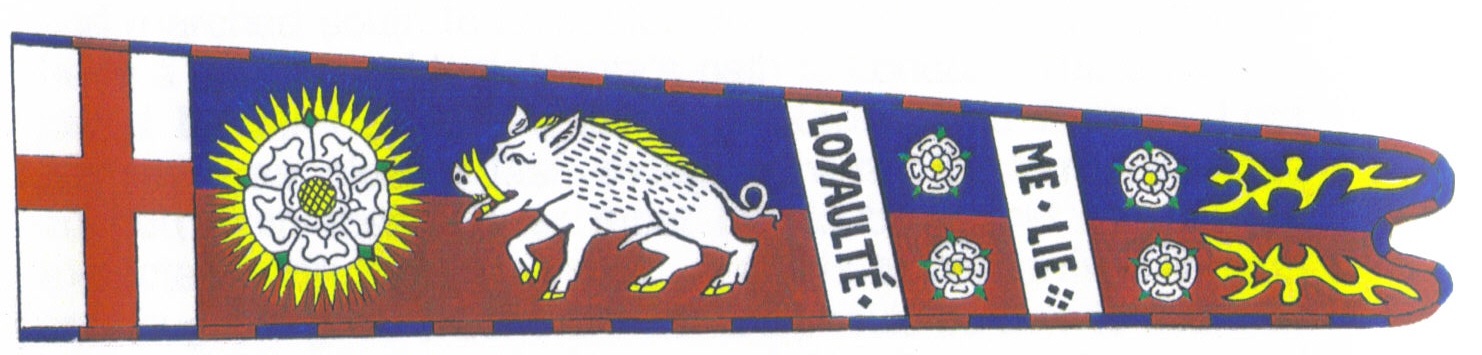
Plantagenet heraldic elements in their royal standard

Replica Medieval side arms such as a squire knight may carry


The end of an age of chivalric warfare died with Richard III
Images of Richard the Third at every turn.

A much photographed pub in Leicester
Walker's renowned pie shop in Leicester, paying tribute

Renowned modeller MedievalMorsels pays tribute with a pie  too!

Tuesday, 17 March 2015

Richard III The Last Journey of the Last Plantagenet


The last Journey of the Last Plantagenet - involving the historic reinterment an anointed King of England - will take place in Leicester and Leicestershire on Sunday 22 March 2015. A cortege carrying the mortal remains of King Richard III will depart from the University of Leicester (which was my father’s alma mater in the 1930’s) through the country and city before arriving at Leicester Cathedral. His remains were found in 2012 beneath a Leicester car park, excavated from the chancel of the long lost medieval Greyfriars church. If you are interested in the discovery please see my earlier posts of 16 and 22 August 2014.

Stained glass window in York Minster


MedievalMorsels is marking these events with a pie bearing heraldic badges of the Yorkist Plantagenets, the white rose of York and the golden sun in splendor adopted by ancestors Richard II and Edward III. The sort of decorated table pie that a cook in a castle or manor would have baked for a feast hosted by his Lord and Lady for a visiting Plantagenet monarch, Richard III of one of his ancestors.


MedievalMorsels has created a 1:12 scale miniature Yorkist Plantagenet heraldic pie! 

The one inch scale dollshouse period pie features white roses and a golden sun

One inch scale dollshouse period pie features white roses and golden suns 
But what of the man?

It was more than 530 years ago that Richard III was crowned King of England. His coronation followed the death of his brother Edward IV and was approved by the Council and Parliament after the legal declaration that his two young nephews were illegitimate (since Edward was bigamously married, having previously been married to Eleanor Butler). The fate of these young boys, formerly in direct line of succession and who became known as the Princes in the Tower, is shrouded in mystery. But Richard is not known to have ever killed a woman, a priest, or a child, unlike the Tudors who came after him.

Richard III was England's last medieval monarch. Only thirty-two when he died, he was born at a time of civil strife in the country. Intermittent, full pitch battles between warring armies of Plantagenet cousins and their supporters broke out, raging for the three decades of Richard's life as rival dynastic claims to the throne were contested. First, towards the end of King Henry VI's reign when Richard's father the Duke of York strove to bolster the Yorkist claim, second the challenges to his brother King Edward IV’s kingship, and lastly and most calamitously for Richard III during his own short, reign of 777 days.
Judging by impartial contemporary or near contemporary accounts Richard was, despite his slender frame and a spine seriously deformed by scoliosis (sideways curvature) from his teenage years, a skilled medieval warrior knight and a seasoned battlefield strategist. He was also an enlightened ruler, whose Parliament brought in reforms which are still in effect today - like the right to bail for those accused of crimes.

Richard was from the Plantagenet House of York. The family badge was the white rose of York, but also adopted was the sun in splendor harking back to Edward III and Richard II. Recall Shakespeare's lines "Now is the winter of our discontent, made glorious summer by this sun of York" a pun on "son of York" in his play Richard III dated 1594. 

Richard's personal badge by which he and his supporters could be recognised was a "sanglier" or wild boar rampant (a hind paw on the ground, three paws raised off the ground), argent (silver but shown on heraldic flags and banners as white), armed (with tusks) and bristled (shown along the boar’s back in a different colour). 

As Joe Ann Ricca explains in an article published by the Richard III Society in August 2012, all sorts of household and military equipment would have carried his personal badge, which was also worn on clothes.  Ricca goes on to explain that at the outset, there is some opinion that by choosing the badge of the white boar, Richard was identifying himself as an individual, separable from his rank, his family, and his in-laws, all of whom had their own particular emblems that he was entitled to display. The choice of a white boar for a personal symbol is not as obvious as that of a lion. But a boar signifies a valiant, wily warrior preferring to die than to save his life by flight. The records for his coronation in 1483 show that Richard ordered 13,000 badges of the white boar, one of these survives in the British Library.

From the stained glass window in York Minster, the rampant white boars, heads erect, stand supporting  the royal shield. The well-known motto of Richard III “Loyaulte Me Lie” (Loyalty Binds Me) appears in a banner in the top of the window, and a banner with a name plate appears at the bottom. The white rose of York and the golden sun in splendor also appear.
Richard's personal badge a pair of "sangliers argents" or white boars

Richard III Banner
Source: Fearn, Discovering Heraldry, Buckinghamshire, 2000, p.68

In this long standard flag a Boar passant (walking with three paws on the ground and the right fore paw raised) looks forward, armed, bristled, tail curled.
All of this make the contemporary and somewhat later accounts of the abuse of Richard’s corpse after being slain at Bosworth Field more obscene, since we are told (1588) that his body was “despoiled to the skin”, was trussed behind his badge “as an hog or another vile beast and so all to besprung with mire and filth, was brought to a church in Leicester for all men to wonder upon and there lastly irreverently buried”.

Some 532 years later, on Sunday 22 March 2015 all that will be put right. The people of Leicester and surrounding towns and villages, and those from much further afield watching simultaneous Channel Four television broadcasts can  wonder and participate. Several days of solemn and reverential process will folllow, culminating in the reinterment of Richard III’s remains with dignity and honour on Thursday 26th March. This will be less than 100 steps from where he lay buried for over 500 years. But this time it will be in a way that at last befits a pious medieval ruler, the last Plantagenet King of England.