Thursday, 12 March 2015

Feeding the five thousand - fish and loaves

An acquaintance of mine has recently learned how to make paint icons. My daughter's former guitar tutor, Milly, explained to me that painting them was a very different kettle of fish (and you'll see why later) compared to using her usual art medium of watercolours. She particularly advised me that the application of gold foil was very tricky indeed. Obviously you wouldn't want a draught breezing through the room when you were applying sections of lustrous and impossibly thin, hammered gold leaf with a sable paintbrush!  Here is the first icon she ever painted.


Now this has got me checking what animal provides the hair for a sable brush, it is in fact a marten. These increasingly rare creatures occupy the northernmost forests of Europe and Asia. Although, it does seem that the most famous and sought after paint brushes are made from hairs from the tail of the kolinsky, a species of weasel rather than an actual sable. No poor (paw) relation that weasel then! The kolinsky is now on the CITES list of endangered species so international trade is problematic and Kolinsky "red sable" paintbrushes will be as rare as hens' teeth!

Another paintbrush with animal association crossed my mind yesterday while I was watching the 2014 film “Mr. Turner” about the later years in the life of J.M.W.Turner, one of my favourite artists. In one scene a pig’s head is bought and then prepared for cooking. Very medieval in fact! Although presently MedievalMorsels models only  boars’ heads.
MedievalMorsels one inch scale Tudor food - boar's head


1:12 scale dollhouse miniature food for a medieval feast

Medieval/Tudor dollshouse food - 12th scale boar's head
Turner’s father was a barber and was expertly shaving the whole pig’s head - I seriously wondered if he was going to recycle and tie the bristles into a painting brush. This did not happen - but I am not so mad to imagine it. Hog bristle, though rare and expensive is apparently the best natural filling material for a wide variety of bristle brushes, with “excellent durability and water resistance”. So there you are.

Getting back to Milly, she was kind enough to give me printed postcards of several copied icons that she has had printed. So I needed to reciprocate….

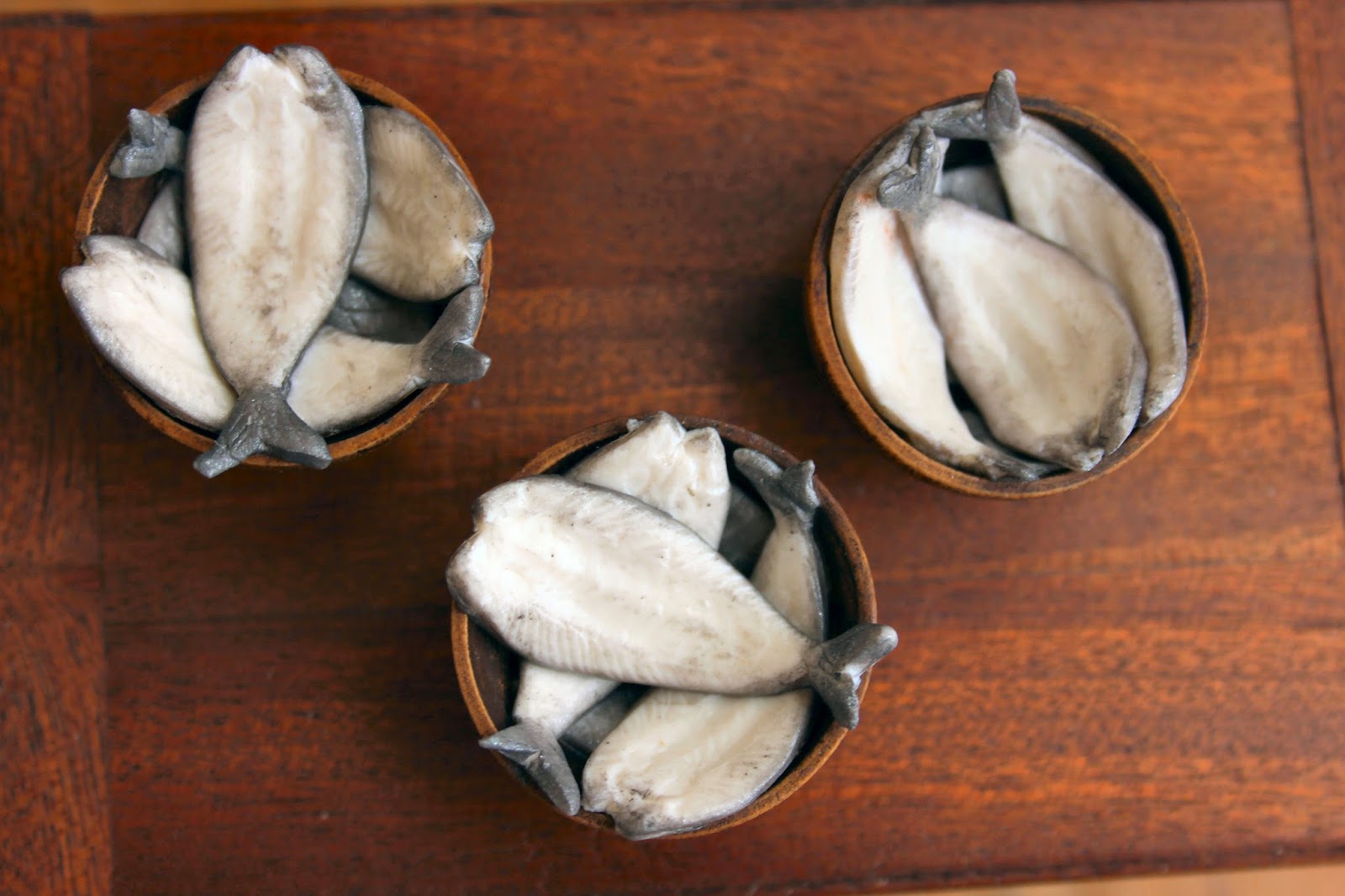
I made her five loaves and two fishes, wrapped in fine muslin and placed in a shallow basket. Whilst I did not photograph them, I did go on to produce two new fishy lines for MedievalMorsels and here they, inspired originally by the parable (the only one recorded in all four Gospels) of the feeding of the five thousand.

And here are some full size loaves for the modern or period dollhouse table or dresser!

Friday, 20 February 2015

Middle Ages sausage supper - bratwurst, brat, chorizo, chourico

I am going on a short holiday soon and I had some vacuum packed sauerkraut in the fridge and did not fancy coming back from holiday to be faced with it once again. Does this herald a bout of spring cleaning? I think not. However, I was looking for a supper dish that would help me see off that sauerkraut.

Well a "new kid on the block" sort of supermarket, one that is giving the big four supermarkets in England (I don't know about Scotland and Wales) a run for their money, supplied the answer. Just steps away from my home I was able to buy some typical Middle Ages sausages, whose German recipe apparently remains little changed today. And here they are, a pale, finely chopped pork sausage or bratwurst (brat in the USA)!
This German favourite since the Middle Ages combines finely chopped pork and spices.


But first, sauerkraut or "sour cabbage". Shredded cabbage that has been fermented by various bacteria. Traditionally, cabbage should be pickled in a stony pot or wooden barrel (not a jar). This been done since before the Dark Ages, all across Europe. Cabbage - pickled or not - was a food mainstay in central Europe, in lands that are presently Germany, and in Hungary and Poland too. Also in Scandinavia, on the northern fringes of Europe, where the growing season was extremely short, so priority had to be given to growing a foodstuffs like cabbage that could be dried or pickled for winter use. Further east, all over Russia, rye bread was eaten with "kvas" a main course soup made from pickled cabbage. At these northern latitudes winter trading of food produce was impossible, so there was great reliance on winter stores and only prized cattle were kept and fed over winter.

Dolls house accessories, miniature vegetables, 12th scale dollhouse food cabbages 

Here are MedievalMorsels 1:12 scale cabbages, dollshouse food for the kitchen, pantry or larder. I do not turn my hand yet to pots or barrels of pickled cabbage, but if the right containers came along I might be tempted to add to my range!

Our European forebears would not have known it, but pickled cabbage is a very rich source of vitamin C. Even so, there was an instinct for these things amongst the sailing community and it was likely that several  barrels found their way onto Middle Ages and Renaissance sailing vessels. Dutch, Spanish and Portuguese vessels in particular plied the oceans of the world, trading in fabulous, otherwise unattainable spices, foods, cloths, porcelain and other imported goods from China, the West Indies and so on. No wonder Thomas Cromwell, in the BBC’s Wolf Hall dramatised from the Man Booker prize winning novels of Hilary Mantel, tries to explain to a hereditary aristocrat Henry Percy, Earl of Northumberland, that real power lies not with ancient title, or even favour from King Henry VIII but with those extending credit to the aristocracy. The rich merchant traders of Antwerp, Lisbon and Florence who delt in those precious goods imported fro one-way trade. I expect they ate sauerkraut too, whilst at sea. But I doubt any trader or pirate could have got a price for a barrel of it, in lands where luscious fruits and spices grow.

Dollhouse miniature food, one inch scale blood pudding, blood sausage

MedievalMorsels has modelled twelfth scale dollshouse food black/blood puddings
And here are one inch scale sausages of various types by MedievalMorsels, dollhouse kitchen accessories for the Medieval kitchen or Renaissance/Tudor dining table.  Recreated “puddings in skins” - black or blood pudding, “white” rice pudding, and toasted marrow puddings. For as long as man has been carnivorous, the intestinal tract of meat animals has been used for pudding and sausage casings.

One inch scale marrow puddings  food for a period Medieval, Renaissance or Tudor dollshouse

 Rice puddings in skins, luxurious 12th scale period dollhouse food by MedievalMorsels

And here are cured sausages for a contemporary rustic or Mediterranean dollshouse setting. Whilst these spicy paprika and garlic flavoured sausages used in modern Mediterranean cooking may not be typical Medieval or Renaissance period fare we cannot actually be sure. Our ancestors in sunny Southern Europe may well have spiced up their sausages to produce the now familiar chorizo.
1:12 cured paprika sausage, chorizo, chourico for a modern dollshouse

mmm - would you believe it, one is being cooked for lunch as I write this blog-post! Seriously, there are oddments in the fridge to be used up before we fly off for a week - probably to buy more chorizo (chourico) sausages to bring home!

Friday, 13 February 2015

What a peach! BBC's Wolf Hall Tudor fruit of course..

We have a few expressions in the English language that rather suggest we were, and to some extent still are, in awe of peaches. We talk of something being a peach "What a peach of a day!" or peachy "That's just peachy!" when its pretty much perfect.

Shakespeare never mentioned peaches in his plays, but used the phrase “peach-coloured” twice. Once when describing the colour of stockings (hose) in Henry IV, and again in Measure for Measure describing the colour of satin.

The peach certainly is a luxurious, summer fruit. At the peak of ripeness, lasting maybe a day but probably just hours, it will have soft flavoursome flesh and be wonderfully juicy on biting. The Romans loved to cultivate peach orchards for their fruit, flowers, scent and shade - they called peaches Persian apples and grew them in most provinces of their empire, as far north as the Loire in France.
   
1:12 scale dollshouse miniature food Tudor platter of luxurious sliced "white" peaches and apricots
But it is sliced apricots, not peaches, that are mentioned in Hilary Mantel's Booker prize winning novel "Wolf Hall". The first of a trilogy about the rise to power of low-born Thomas Cromwell, Henry VIII 's favourite adviser during and after his divorce from Katherine of Aragon, his break with the Church of Rome and his marriage to Anne Boleyn. 

The BBC is currently airing a 6 part historical drama of Mantel's novel and it successor "Bring up the Bodies" her unprecedented second Booker prize winner. Wolf Hall is causing an "all things Tudor" frenzy in the UK at the time of writing - January 2015. We can expect the mini-series it syndicate worldwide. But when?

In Episode 3 of the BBC dramatisation Wolf Hall, a large platter of sliced and whole apricots and white peaches is presented for Thomas Cromwell to examine, before it is placed on the banquet (sweet course) tables at Calais where Henry VIII's court has removed to win France’s King Francois over on the subject of Henry’s divorce. MedievalMorsels has created a one inch scale Wolf Hall dollhouse miniature featuring sliced white peaches and apricots.
MedievalMorsels one inch scale Tudor dollhouse fruit


12th scale Tudor dolls house food, a silver server of Wolf Hall banquet fruit 

Tudor feast luxury fruit plate as seem in BBC TV's Wolf Hall drama

Alexander the Great brought apricots (Prunus armeniaca) and peaches (Prunus persica) to southern Europe, they had already arrived in Armenia and Persia via Middle eastern traders using the earliest trading route - the Silk Road from China. Apricots were prized by the Romans and Greeks who called them the "golden eggs of the sun". The Romans erroneously thought the apricot was a species of plum, an easy mistake to make and in fact they are distantly related. They called peaches Persian apples. 

Later, in Medieval times the Portuguese explorer Marco Polo wrote of yellow and "white" peaches “great delicacies” in China in 1290's. But it took until the 1500's for apricots and the 1700’s for peaches to be successfully cultivated in northern Europe. Reputedly Henry VIII was the first to grow apricots in a garden in England. Before these centuries and definitely in Tudor times - fictional or not - apricots and peaches were a rare, luxury imported item unless you were a pioneer nobleman horticulturalist! So a dainty dish truly befitting a king and to be rationed by individual slices then! Some sticky fingers but no doubt finger bowls or servants carrying towels were in attendance.

Friday, 6 February 2015

Wolf Hall Tudor food - More helpings please

As we reach the midway point of the BBC's six part Tudor drama "Wolf Hall" what fare has been served up so far?

Well, not so much luxurious food because Thomas More's dining gatherings are a little parsimonious, whether it be Lent or not. (There are so many Thomases it can get a bit confusing. My nephew is called Thomas too and it is his birthday on this day of posting!) 

All the same I have been busy creating additions to the MedievalMorsels Wolf Hall Tudor miniature food range,

More is a very religious man and in Episode 2 he serves cooked greens with hard boiled eggs   just four half eggs to be sahred by all the company! And plenty of "maslin" bread, made from a mixture of rye and wheat wholemeal flours. Plenty, yes plenty of bread. In fact there was a preponderance of differently shaped loaves amongst other rather uninspiring foodstuffs, considering he held the role of Chancellor of the Exchequer.


MedievalMorsels Wolf Hall miniature Tudor food, 12th scale greens and boiled eggs


The makings of a Wolf Hall supper courtesy of Chancellor Thomas More

Henry the Fool's view of the supper proceedings, cheese and cabbage garnished with eggs
Oh and he did serves plates with large cheese wedges too.


Tudor dollhouse food, 12th scale miniature Cheddar cheese wheels and wedges 


MedievalMorsels'  dollhouse miniature cheese - 12th scale wedges of Parmesan
In that same dining scene, More's resident "fool" Henry hoots like an excited owl from a minstrel's gallery above the gathered diners. More remarks that he hopes the poor Henry is not suffering the ill effects of too rich a diet. A dining guest and fellow Privy Counsellor remarks unguardedly "No anxiety on that score!" 

To be fair I did spot a bowl of yellow lentil pottage and a plate of cubed white fish too - probably herring and not a more exotic fish! Even when More is himself a dining guest in Episode 1, his host only dare serve him white herring  the so-called "wheat of the sea" and a meat-free staple food for rich and poor alike.
MedievalMorsels'  period dollshouse one inch miniature food, white herring


Dark Ages, Medieval,Tudor miniature food at 12th scale: pickled, brined herring
By Episode 3 of the BBC adaptation of Hilary Mantel's Man Booker prize winning novels Henry VIII and the court, including his mistress Anne Boleyn, have arrived at Calais - a last English outpost in France. Here Henry hopes to get King Francois of France onside in his petition to the Pope. Some food colour at last - a fleeting close-up of a platter of sliced and whole apricots, peaches, apples and plums for Thomas Cromwell to inspect. The rest of the banquet - of sweet courses - was too far distant to positively identify any further dishes. I have made a start on some on those apricots. I have read somewhere that Henry VIII was the first person (excepting the Romans of course) to cutlivate them in his garden.


Saturday, 31 January 2015

Wolf Hall fascinates viewers to BBC

The BBC's "Wolf Hall" adapted from Man Booker prize winning author Dame Hilary Mantel's two novels (Wolf Hall and Bring up the Bodies) continues to win critical acclaim from all quarters. That is despite the authentic dimly candle-lit scenes that have inconvenienced some viewers.

And so I have found myself peering very closely at the food that appears on the screen, in the hope of reproducing as much of it as I can at dollshouse miniature one inch (or 1/12th) scale. I have viewed some scenes many times, using the rewind button.  But even after many views, pencil poised above my notepad, it is sometimes difficult to ascertain precisely what is being served and eaten!

This is a labour of love though! The atmospheric scene settings and acting are impeccable. So what if I cannot tell the difference between a damson and some other English plum in a fruit bowl piled high and barely registering during a brief panning of the camera! I will just have to model both types of fruit. And what were those small white chunks - fish, most probably herring?

So far in Episode One we have been treated to a Cromwell household breakfast of wholegrain brown bread - termed "maslin" bread in  its day - and boiled eggs.
Twelfth scale Tudor food Wolf Hall maslin bread- wholegrain rye and expensive wheat grains

One inch scale Tudor dollhouse food Wolf Hall boiled eggs by MedievalMorsels

Wolf 
Then we have had sumptious cherries on a fine plate offered by Cardinal Wolsey to Thomas Cromwell whilst seated at his writing desk. I did have fun modelling these, choosing a plate for them and posing them with some lovely dollshouse scale medieval maps since I did not have miniature parchment scrolls to hand. Perhaps I need to make some......

MedievalMorsels authentic one inch scale Tudor food -from Wolf Hall Cardinal Wolsey's cherries

Thursday, 29 January 2015

Quinces - a most peculiar fruit?

The Christmas season is well behind us now but I was intrigued at the special seasonal fruit produce that made its way into the shops. Amongst the piles of ever popular oranges were crates of clementines, mountains of mandarins, and sloths of satsumas.

But more ancient and impressive of all of these, in supermarkets in Gibraltar and Spain at least, were the quinces. Looking like a knobbly cross between a pear and an apple, quinces do not soften as they ripen. But quinces are highly aromatic fruits and this quality was not lost on those living in the Middle Ages.
Quinces in a supermarket in Gibraltar, not so pretty are they?

One inch scale dollshouse fruit - quinces for a period setting!
 The quince in fact held a pre-eminent place in Medieval, Tudor and Renaissance kitchens and homes. One quince, or better still a bowl of them, would scent a room. Practically inedible raw, when cooked quince flesh turns pinkish and imparts an aromatic taste to whatever they are cooked with.
A 12th scale pewter dish of quinces lends aroma to a Tudor room.
Quinces made perfect pastes and jellies, the forerunner of marmalade and jam. England's Henry VIII is reported to have been fond of them. Quince jelly  or “membrillo” is still eaten widely in Spain today, mainly as an accompaniment to cheese . I tried it with “manchego” cheese this Christmas! Truth be told I was left a bit non-plussed...

MedievalMorsels : quinces for pie-making in the Tudor kitchen
 So MedievalMorsels just had to model this strange fruit, so versatile and well loved in the Middle Ages.

Perhaps quince fruits are not as rare as we might imagine. Some can be found, not at the greengrocers of in the supermarket, but in domestic gardens! Japonica quince for example - a cultivated quince from Japan. grown for its blossom. Now I come to think of it I have seen largish, scruffy fruits on leafless Japonica bushes in front gardens in winter here in England. I suppose they could be cooked and their aroma sampled! Well this spring, or summer? I will have to have my camera handy and snap some at least!

Thursday, 22 January 2015

At last! Wolf Hall on BBC TV

The first episode of the BBC's eagerly awaited adaptation of Hilary Mantel's Tudor historical drama "Wolf Hall" hit the UK's TV screens last night. Lets hope that UK's TV event of the year is swiftly syndicated world wide. And as a miniaturist I hope too that the number of Tudor dollshouse enthusiasts will grow!


Wolf Hall is the first Booker prize winner of a trilogy by Mantel which charts the rise to power of Thomas Cromwell.  Low born but able, intelligent and aspiring, Cromwell was ready to make his mark in Tudor society. He fast became a confidant of his master Cardinal Wolsey and then, following Wolsey's fall from favour, of Henry VIII himself. He achieved this by working behind the scenes and advising the King during the protracted negotiations with Rome to try to secure the King's divorce from his first wife, Spain's Katherine of Aragon. The eventual divorce, self-proclaimed by Henry in the end, paved the way for his marriage to Anne Boleyn and England's irrevocable break with the Church of Rome.


The BBC has produced a lavish and historically accurate six part historical drama of  Wolf Hall and its Booker winning successor "Bring up the Bodies". Mantel is the first author ever to win two Booker prizes - a feat indeed! I had raced to finish the book before the first episode was transmitted, but I fell short by some 120 pages of its 650. A little bedtime reading left then! As a modeller of Tudor ( and earlier Medieval) foods I have been noting every mention of food, whether simply prepared or consumed. Interestingly Mantel has the achieved feat of two Booker prizes, but has not resorted to description of a feast from what I have read so far. Perhaps this is because Cromwell is not elevated enough as yet in my reading to be invited to attend them.

12th scale Tudor dollhouse food white herring by MedievalMorsels


In episode one we heard Cromwell mention the need for nutmeg and saffron when Wolsey's household is unceremoniously downsized on a winter's night from York Palace to Esher Place. These were exotic and expensive spices, traded by merchants in the Middle East. But we also see Wolsey in happier times offering Cromwell a pewter plate of cherries (it must be early summer). Later on in the episode, Cromwell is dining with Thomas More who is at odds with Wolsey and stands in the way of Henry's divorce. Their mutual host remarks that it seems as if More dislikes his herring. Later, to point out the difference between himself and More, Cromwell compliments his host and the herring - asking for he recipe of the accompanying sauce.   

Tudor/Medieval dollshouse food one inch brined and pickled herring

MedievalMorsels models one inch white herring for your Tudor dollshouse kitchen scene, maybe I need to add a pewter plate of 12th scale herring, cubed with white sauce to eat with fingers as we saw Cromwell do. A new range of authentic medieval and Tudor dollhouse food for Wolf Hall foodie enthusiasts beckons! Certainly I am going to work on some plates of luscious cherries! My sister and her co-proprietor Gillian already model these in lovely punnets, as well as on cherry pie making preparation boards and a cherry pie-making table in their Etsy shop "abasketof...".