Friday, 6 February 2015

Wolf Hall Tudor food - More helpings please

As we reach the midway point of the BBC's six part Tudor drama "Wolf Hall" what fare has been served up so far?

Well, not so much luxurious food because Thomas More's dining gatherings are a little parsimonious, whether it be Lent or not. (There are so many Thomases it can get a bit confusing. My nephew is called Thomas too and it is his birthday on this day of posting!) 

All the same I have been busy creating additions to the MedievalMorsels Wolf Hall Tudor miniature food range,

More is a very religious man and in Episode 2 he serves cooked greens with hard boiled eggs   just four half eggs to be sahred by all the company! And plenty of "maslin" bread, made from a mixture of rye and wheat wholemeal flours. Plenty, yes plenty of bread. In fact there was a preponderance of differently shaped loaves amongst other rather uninspiring foodstuffs, considering he held the role of Chancellor of the Exchequer.


MedievalMorsels Wolf Hall miniature Tudor food, 12th scale greens and boiled eggs


The makings of a Wolf Hall supper courtesy of Chancellor Thomas More

Henry the Fool's view of the supper proceedings, cheese and cabbage garnished with eggs
Oh and he did serves plates with large cheese wedges too.


Tudor dollhouse food, 12th scale miniature Cheddar cheese wheels and wedges 


MedievalMorsels'  dollhouse miniature cheese - 12th scale wedges of Parmesan
In that same dining scene, More's resident "fool" Henry hoots like an excited owl from a minstrel's gallery above the gathered diners. More remarks that he hopes the poor Henry is not suffering the ill effects of too rich a diet. A dining guest and fellow Privy Counsellor remarks unguardedly "No anxiety on that score!" 

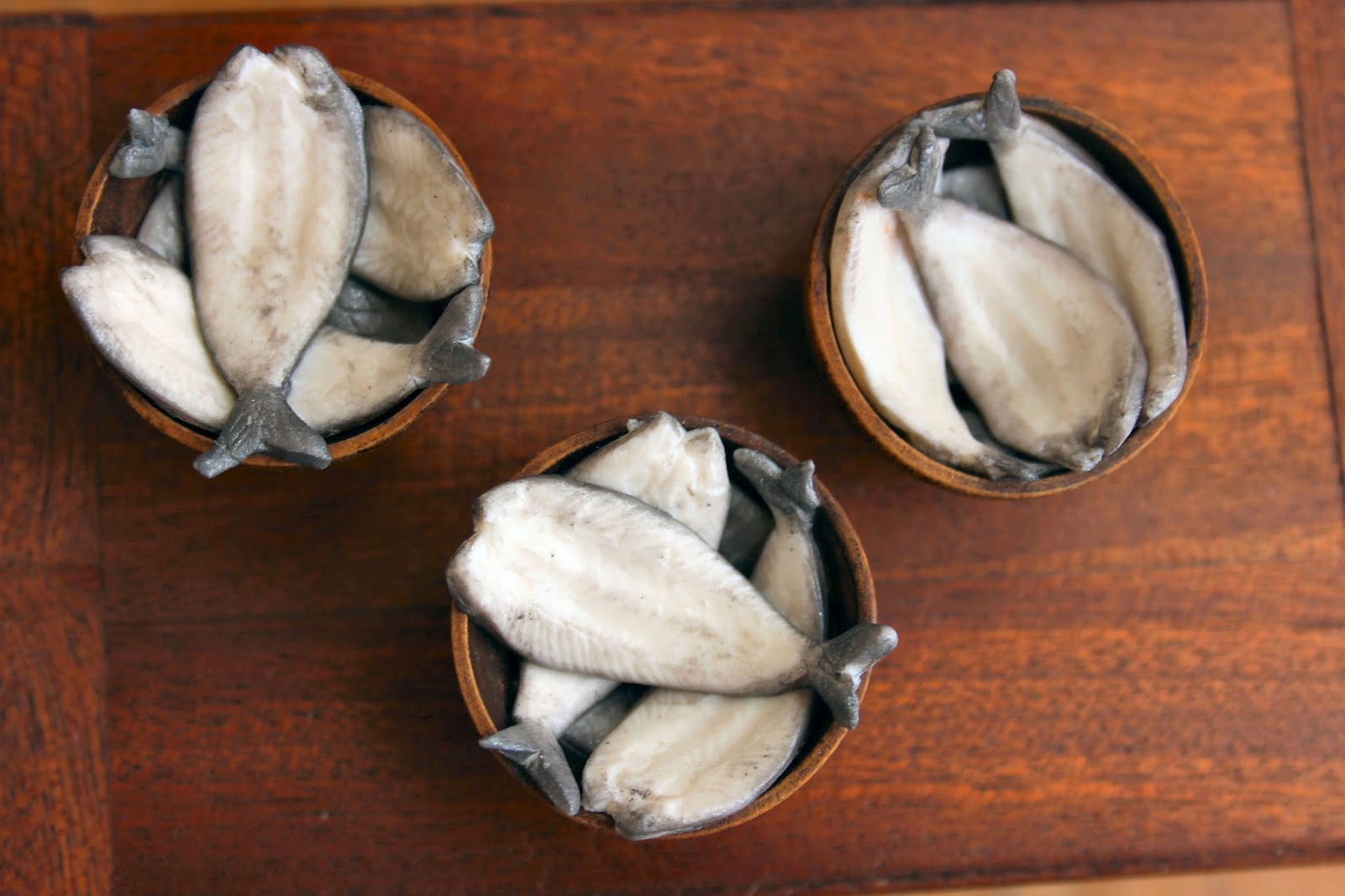
To be fair I did spot a bowl of yellow lentil pottage and a plate of cubed white fish too - probably herring and not a more exotic fish! Even when More is himself a dining guest in Episode 1, his host only dare serve him white herring  the so-called "wheat of the sea" and a meat-free staple food for rich and poor alike.
MedievalMorsels'  period dollshouse one inch miniature food, white herring


Dark Ages, Medieval,Tudor miniature food at 12th scale: pickled, brined herring
By Episode 3 of the BBC adaptation of Hilary Mantel's Man Booker prize winning novels Henry VIII and the court, including his mistress Anne Boleyn, have arrived at Calais - a last English outpost in France. Here Henry hopes to get King Francois of France onside in his petition to the Pope. Some food colour at last - a fleeting close-up of a platter of sliced and whole apricots, peaches, apples and plums for Thomas Cromwell to inspect. The rest of the banquet - of sweet courses - was too far distant to positively identify any further dishes. I have made a start on some on those apricots. I have read somewhere that Henry VIII was the first person (excepting the Romans of course) to cutlivate them in his garden.


Saturday, 31 January 2015

Wolf Hall fascinates viewers to BBC

The BBC's "Wolf Hall" adapted from Man Booker prize winning author Dame Hilary Mantel's two novels (Wolf Hall and Bring up the Bodies) continues to win critical acclaim from all quarters. That is despite the authentic dimly candle-lit scenes that have inconvenienced some viewers.

And so I have found myself peering very closely at the food that appears on the screen, in the hope of reproducing as much of it as I can at dollshouse miniature one inch (or 1/12th) scale. I have viewed some scenes many times, using the rewind button.  But even after many views, pencil poised above my notepad, it is sometimes difficult to ascertain precisely what is being served and eaten!

This is a labour of love though! The atmospheric scene settings and acting are impeccable. So what if I cannot tell the difference between a damson and some other English plum in a fruit bowl piled high and barely registering during a brief panning of the camera! I will just have to model both types of fruit. And what were those small white chunks - fish, most probably herring?

So far in Episode One we have been treated to a Cromwell household breakfast of wholegrain brown bread - termed "maslin" bread in  its day - and boiled eggs.
Twelfth scale Tudor food Wolf Hall maslin bread- wholegrain rye and expensive wheat grains

One inch scale Tudor dollhouse food Wolf Hall boiled eggs by MedievalMorsels

Wolf 
Then we have had sumptious cherries on a fine plate offered by Cardinal Wolsey to Thomas Cromwell whilst seated at his writing desk. I did have fun modelling these, choosing a plate for them and posing them with some lovely dollshouse scale medieval maps since I did not have miniature parchment scrolls to hand. Perhaps I need to make some......

MedievalMorsels authentic one inch scale Tudor food -from Wolf Hall Cardinal Wolsey's cherries

Thursday, 29 January 2015

Quinces - a most peculiar fruit?

The Christmas season is well behind us now but I was intrigued at the special seasonal fruit produce that made its way into the shops. Amongst the piles of ever popular oranges were crates of clementines, mountains of mandarins, and sloths of satsumas.

But more ancient and impressive of all of these, in supermarkets in Gibraltar and Spain at least, were the quinces. Looking like a knobbly cross between a pear and an apple, quinces do not soften as they ripen. But quinces are highly aromatic fruits and this quality was not lost on those living in the Middle Ages.
Quinces in a supermarket in Gibraltar, not so pretty are they?

One inch scale dollshouse fruit - quinces for a period setting!
 The quince in fact held a pre-eminent place in Medieval, Tudor and Renaissance kitchens and homes. One quince, or better still a bowl of them, would scent a room. Practically inedible raw, when cooked quince flesh turns pinkish and imparts an aromatic taste to whatever they are cooked with.
A 12th scale pewter dish of quinces lends aroma to a Tudor room.
Quinces made perfect pastes and jellies, the forerunner of marmalade and jam. England's Henry VIII is reported to have been fond of them. Quince jelly  or “membrillo” is still eaten widely in Spain today, mainly as an accompaniment to cheese . I tried it with “manchego” cheese this Christmas! Truth be told I was left a bit non-plussed...

MedievalMorsels : quinces for pie-making in the Tudor kitchen
 So MedievalMorsels just had to model this strange fruit, so versatile and well loved in the Middle Ages.

Perhaps quince fruits are not as rare as we might imagine. Some can be found, not at the greengrocers of in the supermarket, but in domestic gardens! Japonica quince for example - a cultivated quince from Japan. grown for its blossom. Now I come to think of it I have seen largish, scruffy fruits on leafless Japonica bushes in front gardens in winter here in England. I suppose they could be cooked and their aroma sampled! Well this spring, or summer? I will have to have my camera handy and snap some at least!

Thursday, 22 January 2015

At last! Wolf Hall on BBC TV

The first episode of the BBC's eagerly awaited adaptation of Hilary Mantel's Tudor historical drama "Wolf Hall" hit the UK's TV screens last night. Lets hope that UK's TV event of the year is swiftly syndicated world wide. And as a miniaturist I hope too that the number of Tudor dollshouse enthusiasts will grow!


Wolf Hall is the first Booker prize winner of a trilogy by Mantel which charts the rise to power of Thomas Cromwell.  Low born but able, intelligent and aspiring, Cromwell was ready to make his mark in Tudor society. He fast became a confidant of his master Cardinal Wolsey and then, following Wolsey's fall from favour, of Henry VIII himself. He achieved this by working behind the scenes and advising the King during the protracted negotiations with Rome to try to secure the King's divorce from his first wife, Spain's Katherine of Aragon. The eventual divorce, self-proclaimed by Henry in the end, paved the way for his marriage to Anne Boleyn and England's irrevocable break with the Church of Rome.


The BBC has produced a lavish and historically accurate six part historical drama of  Wolf Hall and its Booker winning successor "Bring up the Bodies". Mantel is the first author ever to win two Booker prizes - a feat indeed! I had raced to finish the book before the first episode was transmitted, but I fell short by some 120 pages of its 650. A little bedtime reading left then! As a modeller of Tudor ( and earlier Medieval) foods I have been noting every mention of food, whether simply prepared or consumed. Interestingly Mantel has the achieved feat of two Booker prizes, but has not resorted to description of a feast from what I have read so far. Perhaps this is because Cromwell is not elevated enough as yet in my reading to be invited to attend them.

12th scale Tudor dollhouse food white herring by MedievalMorsels


In episode one we heard Cromwell mention the need for nutmeg and saffron when Wolsey's household is unceremoniously downsized on a winter's night from York Palace to Esher Place. These were exotic and expensive spices, traded by merchants in the Middle East. But we also see Wolsey in happier times offering Cromwell a pewter plate of cherries (it must be early summer). Later on in the episode, Cromwell is dining with Thomas More who is at odds with Wolsey and stands in the way of Henry's divorce. Their mutual host remarks that it seems as if More dislikes his herring. Later, to point out the difference between himself and More, Cromwell compliments his host and the herring - asking for he recipe of the accompanying sauce.   

Tudor/Medieval dollshouse food one inch brined and pickled herring

MedievalMorsels models one inch white herring for your Tudor dollshouse kitchen scene, maybe I need to add a pewter plate of 12th scale herring, cubed with white sauce to eat with fingers as we saw Cromwell do. A new range of authentic medieval and Tudor dollhouse food for Wolf Hall foodie enthusiasts beckons! Certainly I am going to work on some plates of luscious cherries! My sister and her co-proprietor Gillian already model these in lovely punnets, as well as on cherry pie making preparation boards and a cherry pie-making table in their Etsy shop "abasketof...".


Saturday, 6 December 2014

Partridges in pears trees?

Well its almost Christmas, there is a Cadbury's advent calendar in the house. But my thoughts turned to the old rhyme "The Twelve Days of Christmas". Surely it must be medieval in origin?

Specifically I was keen for MedievalMorsels to offer 12th scale miniature pears by this December, to accompany my dollshouse miniature partridges. Mission accomplished this week!
Bowls of pears, 12th scale dolls house food, by MedievalMorsels

A beautiful British Christmas stamp (1 of 12!) issued in 1977

Roasted partridges one inch dollhouse miniature by MedievalMorsels
 Strictly a ground bird the partridge was never likely to be found in pear trees! This misunderstanding seems to have arisen from mistranslation of the French song. Une perdix is French for a partridge and une perdrix for a pear tree! An easy mistaken association for an English speaker to make in translation.  I have an ambitious plan for next year, which will rely on abundant medieval themed poultry!
The full 1977 Christmas set of British commemorative stamps

Namely scale models for a Medieval or Tudor dolls house. Two turtle doves and three French hens will be required. I think either in their plumage, or toasty and spit roasted!  There is little obvious difference between a pigeon and a turtle dove when its roasted luckily for me. I suspect from research I have done, and the stamp seems to bear this out, that French hens were a short-legged variety. At the minute I just model a standard chicken - but is a fat neutered male - a capon.
Not hens but capons modelled by MedievalMorsels
Two turtle doves or at least common or garden pigeons


Four calling or colley birds - I will certainly need to find out about these. From the stamp they look like a member of the corvid (crows, ravens etc) family but perhaps the smaller blackbird, known for its beautiful song and thus a calling bird?  Six geese present no problem, nor their eggs.
MedievalMorsels takes on roast goose for a Tudor dollshouse 

One inch scale dollshouse miniature food - geese eggs

My biggest challenge will be seven swans swimming atop medieval pies. There are some stupendous models out there. I may have to make a medieval swan-shaped biscuits instead. Lets see how my modelling progresses in 2015!

Sunday, 30 November 2014

Purple carrots - who would believe it?

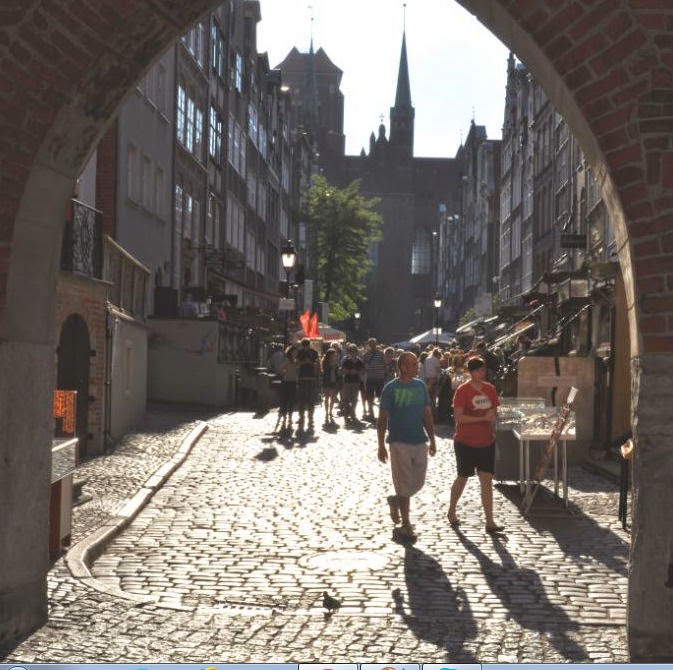
I visited the city of Gdansk in Poland at the end of October. I had not realised what a medieval treasure it is, one of Europe’s largest historical centres apparently. A most welcome revelation in fact.  But what impressed me greatly amongst some of the largest surviving  medieval brick buildings in the world  was….wait for it….a market stall full of colourful carrots!


Gothic Town Hall photo by Gdansk City Guide
But first, some architecture -  lovingly and painstakingly restored. Because in 1945, at the end of World War II, Gdansk was reduced to rubble. The city authority took a decision to rebuild from the bombed ruins, faithfully reproducing  original external architecture and internal decoration.
Gate in City wall, Mariacki Street. Photo: Gdansk City Guide


St Mary's cathedral photo Gdansk City Guide
This was achieved first, by using historic and contemporary sources and second, by using as much reclaimed medieval brick and other building material as could be sorted and salvaged from the devastated townscape. The project is still ongoing, witness medieval warehouse walls on the city’s Granary Isle still to be restored. However, one restored granary now serves as the home of the Baltic Philharmonic Orchestra and another is an enticing four star hotel.  


Today in Gdansk’s Stare Miasto (Old Town) you are carried back to the Middle Ages. In amongst the reconstructions are many authentic old buildings. According to the Gdansk City Guide  most streets are located where they were in medieval times, and many retain their original 500 year old names.

Above all Gdansk was a medieval harbour town, a Hanseatic trading port whose storerooms and warehouses on the wharves lay side by side with entry gates through the medieval walls, allowing daytime access to people and produce. Nestled amongst these impressive utilitarian buildings, all made of brick, are the town houses built by rich merchant guildsmen as well as palatial houses built for barons and kings. My home town of King’s Lynn in Norfolk was also a Hanseatic trading port, there is absolutely no doubt that  sailing vessels laden with timber, wool, grain, herrings and more plied between the two.


As a student of geology I did wonder where the nearest stone quarry was - obviously many miles distant to make it cost effective for medieval man to fire clay bricks instead. A labour intensive process demanding forests of wood, or charcoal produced from the trees, to fire those brick ovens. This area of Europe was in fact heavily glaciated as recently as 20,000 years ago. The present landscape is swathed in hundreds of metres of loose glacial deposits, including glacial clays laid down directly by continent-wide the ice sheets. So solid bedrock was inaccessible. Itinerant medieval stone masons would find no work in Gdansk!


Now to those Gdansk carrots, an ancient variety whose natural colour is purple. And in Medieval times this was the case, but genetic variation commonly resulted in yellow and white carrots too. It is from such carrots that the today’s now common orange variety was bred, probably by Dutch horticulturalists.
MedievalMorsels authentic carrots for a historic dolls house!


The real thing - display of multi-coloured carrots in Gdansk market!


Here too are MedievalMorsels one inch scale carrots, modelled at one inch scale for your medieval, gothic or Tudor dollhouse! Or to collect as a desirable miniature!

Saturday, 15 November 2014

Boars' Heads


I spent last weekend at a miniaturist workshop working with modelling clays. We learned several new clay techniques. And, importantly, corrected faults in our improvised processes under the tutelege of Angie Scarr. Angie is a renowned polymer clay miniaturist who has taken the miniaturist polymer clay art-form leap years forward. She has over 30 years experimented with and fully understands the properties of the clay. But she also closely observes colour, texture, repeating patterns in nature so that her models are truly lifelike.
Now I don’t want to bore you (I’m sorry but a pun is intended here) with an account of the magnificently realistic peeled apples, oranges and bananas that we made. Or the strawberry plants that were left in various stages of assembly at the end of our second day. Yes, some of us were rather slow workers even though we had a small strawberry planter to fill!  Nor shall I “show and tell” the wonderful cuts of salmon and whole fish we made, with shrimps on the sid. These will no doubt feature in a later blog. and they will certainly feature in my MedievalMorsels online shop.  Except the bananas which, without checking, I am reasonably sure did not feature in a Middle Ages or early Renaissance diet. But every other food type we modelled over three days  could be found on the Medieval high table.

I do want to mention that I was intrigued that we drove daily to and from the course in Kent through a village called Boar’s Head. Here I should thank my brother-in-law Jon for driving my sister Lucy and I rather early each morning - yes we were keen.

Now I have always felt exposed to criticism, ever since I first opened my MedievalMorsels online shop in February of this year, because I did not model a boar’s head. Afterall it is what most people think of when first considering Medieval and Tudor food. Well admittedly we might think of the more usually served pig’s heads as well…


So I had to bite the bullet and model one. Well last night I modelled three and here they are.


One is decorated with strawberry flowers, leaves and berries. Oops I’ll never finish that strawberry plant now! 

They make an outing to a new UK Miniatura event in Solihull tomorrow Sunday 16 November - lets see if any dolls house enthusiasts out there like them enough to buy them! To do that they would have to drop by the “Abasketof…” stall where my sister and her friend Gillian’s beautiful contemporary food and table settings will be on display. We both hope for a successful day at this new event in the internationally renowned Miniatura calendar.